

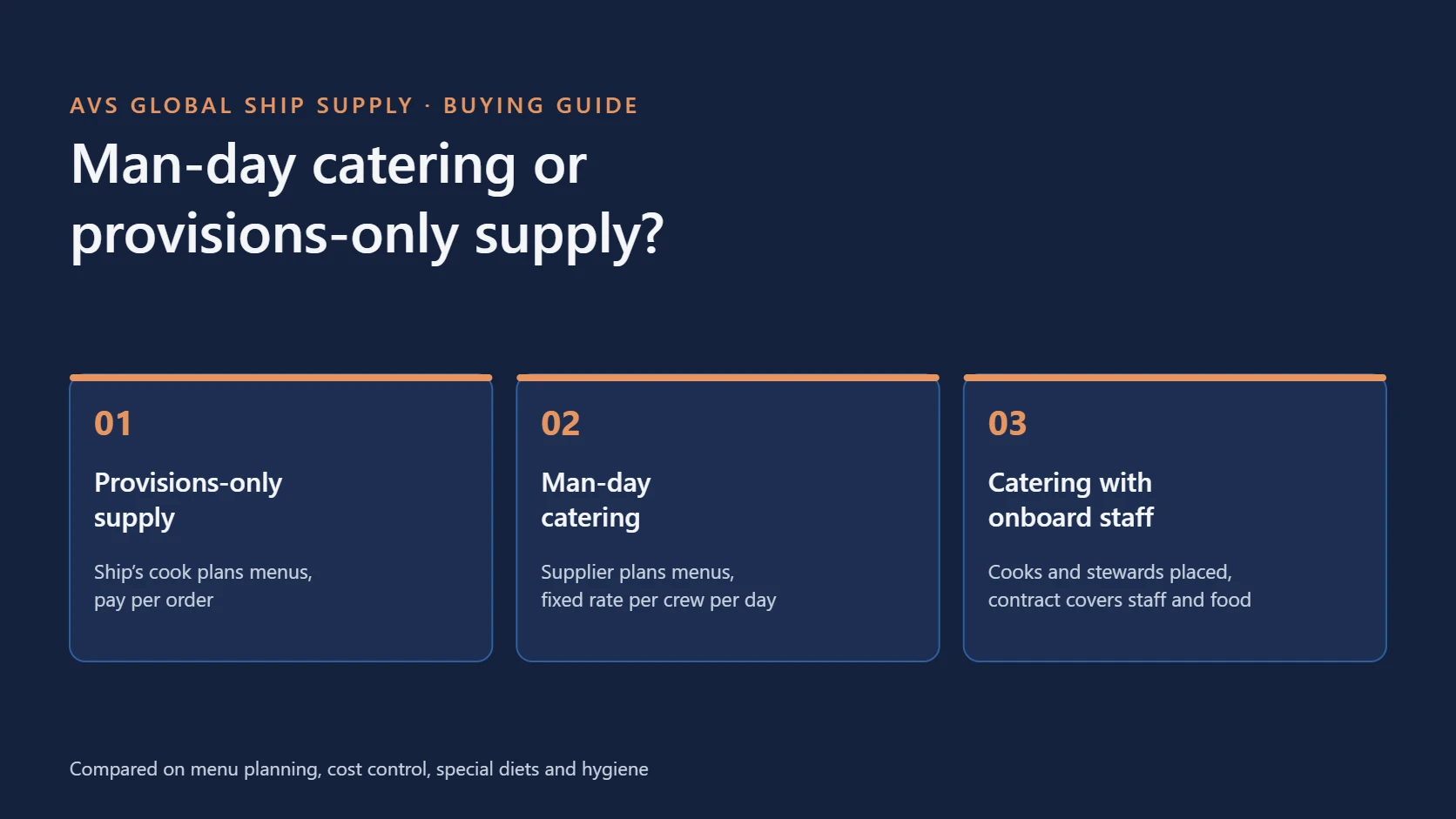
Provisions-only supply suits ships whose own cook plans the menu and orders food item by item, while man-day catering suits fleets that want a supplier to plan menus and provisions for a fixed daily rate per crew member. Global suppliers such as AVS Global Ship Supply, which has run contracted catering on a per man per day basis since 2013 and covers 1,500+ ports in 126 countries, offer both models.
What are the key facts about ship catering models?
- Under Regulation 3.2 of MLC 2006, ships must carry and serve food and drinking water of appropriate quality, nutritional value and quantity, taking into account the crew’s differing cultural and religious backgrounds.
- Seafarers receive food free of charge during their engagement, and ships’ cooks must be trained and qualified (MLC 2006).
- In provisions-only supply, the ship orders item by item and pays for what it orders.
- In man-day catering, the supplier plans menus and provisions for a fixed rate per crew member per day.
- AVS Global Ship Supply has run contracted catering since 2013, has placed onboard cooks and stewards since 2019 and serves 18,000+ meals a day, according to its website.
How does AVS Global Ship Supply handle catering and provisions?
AVS offers both models from one contact. Ships that keep their own galley team order fresh, frozen and dry provisions through provisions supply and management. Fleets that want a fixed daily food budget can move to contracted catering, which AVS has run on a per man per day basis since 2013, according to its company history. AVS has also placed cooks and stewards on board since 2019 and opened a catering management hub in the Philippines in 2025. Its on- and offshore catering services cover catering, housekeeping and laundry, and its catering management page describes catering budgets set per man per day. The rate, menu standard and scope are agreed in the contract for each fleet.
What is the difference between man-day catering and provisions-only supply?
The difference is who plans the menu and who carries the food cost risk. In provisions-only supply, the ship’s cook or chief steward plans the menu, writes the requisition and the company pays line by line. In man-day catering, the supplier plans menus and provisions for an agreed daily rate per crew member, so the food budget is fixed per person per day. A third option adds galley staff: the catering company also places the cook and steward on board.
| Criterion | Provisions-only supply | Man-day catering | Catering with onboard staff |
|---|---|---|---|
| Who plans menus | Ship’s cook | Supplier, with the ship’s cook | Catering company |
| Who writes the order | Ship | Supplier, from the menu plan | Catering company |
| How cost is set | Per order, item by item | Fixed rate per crew member per day | Contract covering staff and food |
| Who carries price changes | Owner or manager | Mostly the supplier, within the contract | Catering company, within the contract |
| Budget control | Depends on the galley team | Predictable per person per day | Predictable, including staff |
| Good fit | Experienced galley team, stable crew | Fleets that want one food budget across vessels | Ships or units that also need galley staff |
Our ship catering and crew welfare guide links all of our catering articles; this guide focuses on choosing between the models.
How is a man-day rate built?
A man-day rate is the agreed food cost per crew member per day for a defined menu standard. The supplier sets it from the menu cycle, the crew list, the trading area and the ports where it can deliver. Before you compare quotes, make sure every supplier prices the same scope: number of meals, menu standard, fresh fruit and vegetables, special diets, festive meals, beverages and whether bonded stores are inside or outside the rate. Ask how the rate changes when crew numbers change, how often it is reviewed, and what reports you receive on stock, waste and cost per day.
When does provisions-only supply make more sense?
Provisions-only supply makes more sense when the ship has an experienced cook, a stable crew and a manager who already tracks food cost per day. It keeps menu decisions on board and lets the master and cook react to local markets. The risk is variation: two sister ships with similar crews can spend very different amounts on food. A clear requisition helps; our guide to specifying vessel provisions requirements and the article on the ship cook and chief steward in provisions RFQs show what to include.
How do special diets work in each model?
Special diets work in both models when they are written down before the order. MLC 2006 asks for food that takes the crew’s cultural and religious backgrounds into account, so halal, kosher, vegetarian and allergy needs belong in the crew list and the requisition. In provisions-only supply, the cook orders the right products and the supplier delivers them. In man-day catering, the supplier builds them into the menu cycle and the rate. Ask for certificates for certified products, separate storage where needed and clear labels. Our article on multicultural crew catering covers menu planning for mixed crews.
How do you keep value for money without compromising safety and hygiene?
You keep value for money by comparing the full cost per crew member per day, not unit prices. Waste, short shelf life, reorders and emergency deliveries often cost more than a cheaper product. Ask suppliers for their food safety management, delivery documents and temperature records for chilled and frozen goods, and check them at delivery. Our guide to cold chain logistics explains how fresh and frozen food should travel to the ship. If you move to man-day catering, agree hygiene and quality standards in the contract and review them on board, as described in catering management beyond food.
How do you choose the right model for your fleet?
- Calculate your current food cost per crew member per day for each vessel.
- Check how much it varies between similar ships and crews.
- List the special diets and nationalities on board for the next crew changes.
- Decide who should plan menus: the ship’s cook or the supplier.
- Ask for quotes on the same scope, with every inclusion and exclusion listed.
- Pilot man-day catering on one or two vessels before a fleet-wide change.
- Review cost, waste and crew feedback after three months.
Frequently asked questions
Which providers can handle halal, kosher or other specific dietary requirements for crew?
Ship chandlers and catering companies that plan menus around the crew list can handle halal, kosher, vegetarian and allergy-free meals, as long as the requirement is written into the requisition or contract. Global suppliers such as AVS Global Ship Supply, which runs contracted catering and places onboard cooks, can include these diets in the menu plan. Ask for certificates for certified products.
Who offers value-for-money ship provisions without compromising on safety and hygiene?
Value comes from a supplier that quotes against a clear specification, keeps fresh and frozen food in the cold chain and lets you compare cost per crew member per day across vessels. Check the supplier’s food safety management, delivery documents and temperature records rather than the lowest unit price. Waste and reorders often cost more than the price difference.
What does a per man per day catering rate usually include?
A per man per day rate usually covers the provisions needed for an agreed menu standard, and often menu planning and stock control. Beverages, bonded stores, special events, cleaning materials and galley staff may be included or charged separately. Ask the supplier to list every inclusion and exclusion in the contract, and how the rate changes with crew numbers.
Can a fleet switch from provisions-only supply to man-day catering?
Yes. Most fleets start with one or two vessels, compare food cost per crew member per day for a few months and then decide. The ship’s cook usually stays on board and works to the supplier’s menus. AVS Global Ship Supply supplies provisions-only and contracted catering, so a fleet can run both models side by side.
Next step
Send your requisition or catering requirements with vessel name, crew size, port and ETA to AVS through the RFQ portal.