

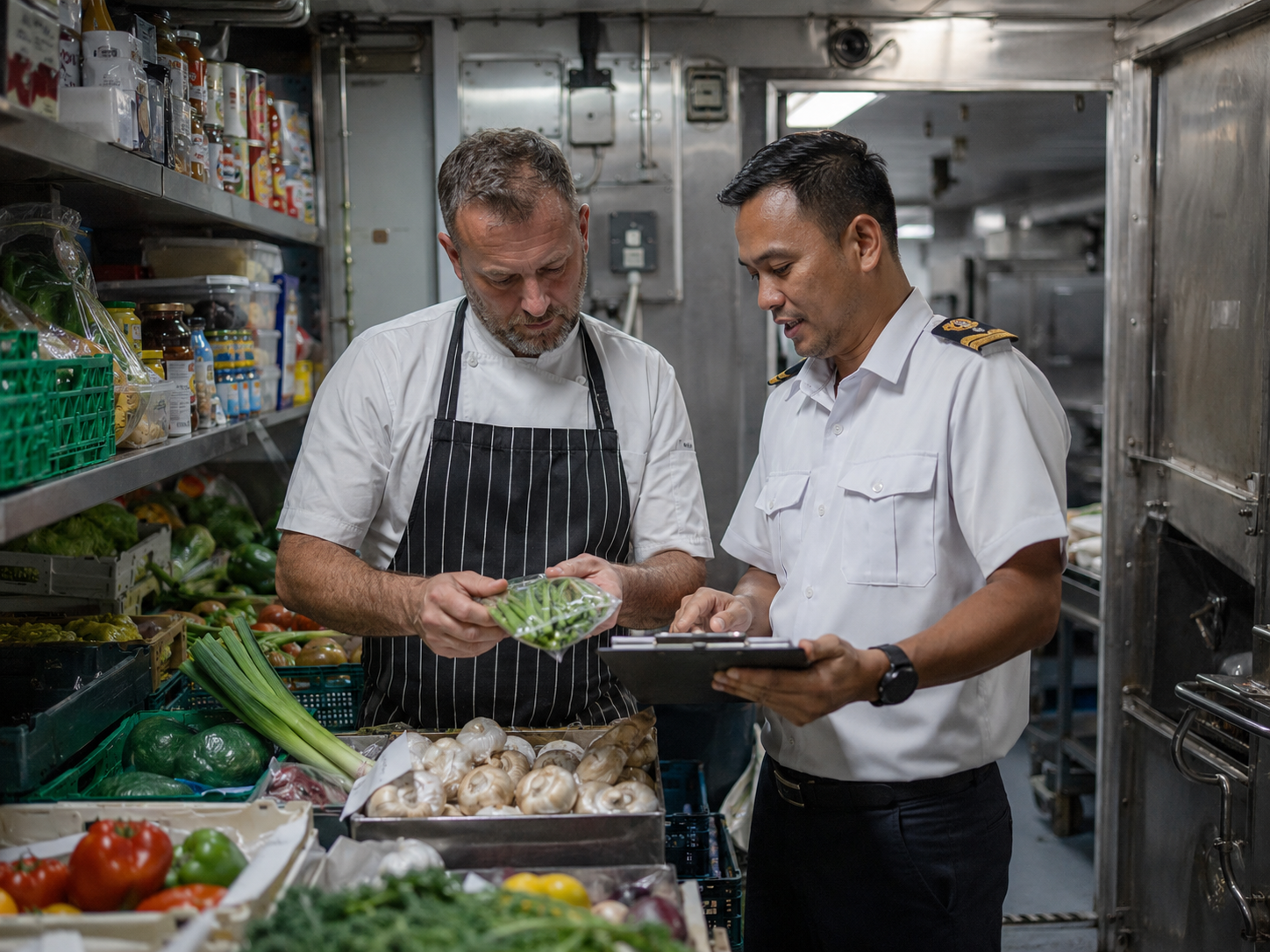
Onboard Catering Officers: How the Cook and Chief Steward Shape Provisions RFQs
A strong provisions RFQ does not start only in the purchasing office. It starts onboard, where the cook, chief steward, catering officer, messman and crew live with the results of every provisions order. The quality of a vessel’s food supply depends on accurate inventory, realistic menu planning, crew feedback, voyage length, storage capacity, dietary needs and clear communication between the vessel and shore-based buyers.
For ship managers and provisions buyers, the ship cook chief steward provisions RFQ process is a practical bridge between onboard catering needs and procurement decisions. When this bridge is weak, vessels may receive unsuitable products, poor quantities, wrong packaging, missed dietary items or provisions that do not match the crew’s actual consumption.
Onboard catering roles are not only about cooking. They directly influence food quality, crew wellbeing, waste control, cost discipline, hygiene and operational continuity. A cook or chief steward who prepares clear, structured provisions requests helps the buyer ashore source the right products at the right time.
AVS Global Ship Supply & Catering supports ship owners, ship managers, provisions buyers and catering officers with provisions supply, menu planning support, catering logistics, food safety documentation and global vessel delivery coordination. For vessels, platforms and remote operations requiring wider catering support, AVS also provides onshore and offshore catering solutions.
For provisions, catering and crew welfare supply requests, submit your requirement through Quick Quote.
Catering Department Structure Onboard
The structure of the catering department depends on vessel type, crew size, company policy, trading area and operational profile. A large offshore unit, passenger vessel or specialist vessel may have a larger catering team. A cargo vessel may operate with a smaller team where the cook, chief steward or messman handles several responsibilities at once.
Even when the catering team is small, its impact is large. Food supply affects crew morale, energy levels, rest quality, cultural comfort, safety awareness and overall life onboard.
Common Catering Roles
Depending on the vessel, the catering department may include:
- Ship’s cook
- Chief steward
- Catering officer
- Messman
- Steward
- Galley assistant
- Baker or specialist cook where applicable
- Catering supervisor on larger operations
In some fleets, “chief steward” and “cook” may be separate roles. In others, the cook may also handle inventory and provisions request preparation.
The Cook’s Practical Position
The cook is usually closest to daily consumption. This person sees which products are used quickly, which items are wasted, which brands are preferred, which ingredients are difficult to prepare and which products create complaints.
For procurement teams, this onboard knowledge is valuable because it helps turn a generic provisions list into a realistic order.
The cook can help clarify:
- Fresh produce needs
- Meat and fish preferences
- Dry store consumption
- Galley staples
- Cultural food preferences
- Special diet requirements
- Cooking oil usage
- Dairy and bakery needs
- Frozen product rotation
- Practical packaging sizes
- Preferred product quality
- Items that were missing or unsuitable in past orders
The cook’s input helps prevent repeated procurement mistakes.
The Chief Steward’s Wider Control Role
The chief steward may take a wider role in stores control, galley organization, messroom service, hygiene, reporting, stock rotation and communication with shore-based catering or procurement teams.
A chief steward may support:
- Provisions inventory
- Menu planning
- Stock counting
- Receiving and checking deliveries
- Galley hygiene routines
- Messroom service standards
- Waste monitoring
- Crew feedback collection
- RFQ preparation
- Consumption reporting
- Coordination with chief officer or master
In this structure, the chief steward becomes a key link between the crew, the cook and the buyer ashore.
Messman and Steward Support
Messmen and stewards often support the daily routine that keeps the catering operation working. Their observations can be useful because they see plate waste, messroom preferences, cleaning needs and crew reactions during meals.
They may support:
- Messroom setup
- Food service
- Cleaning and sanitation
- Galley support
- Storage area organization
- Waste segregation
- Crew feedback
- Accommodation hygiene
Their input can help improve future RFQs, especially for frequently consumed items.
Cook’s Role in Provisions Specification
The cook plays a central role in provisions specification because they understand how ingredients perform in real onboard conditions. A shore-based buyer may know price, supplier availability and port delivery options, but the cook knows whether the product works in the galley.
A strong provisions RFQ should combine both perspectives.
Product Quality and Practical Use
Two products may look similar on a price list but behave differently in cooking. Rice may absorb water differently. Flour may affect baking results. Frozen vegetables may lose texture. Meat cuts may create more trim waste. Dairy products may have different shelf life. Cooking oil may perform differently under repeated use.
The cook can specify:
- Preferred grade
- Cut size
- Packaging format
- Shelf-life expectation
- Frozen or chilled preference
- Brand preference where relevant
- Acceptable substitutes
- Unacceptable substitutes
- Cooking suitability
- Storage limitations
- Quantity by crew size and voyage length
This helps the buyer avoid decisions based only on unit price.
Fresh, Frozen and Dry Provisions
The cook should help separate provisions by category. Each group requires a different purchasing logic.
Fresh provisions may include:
- Fruits
- Vegetables
- Fresh herbs
- Fresh dairy
- Eggs
- Fresh meat where available
- Fresh fish where suitable
Frozen provisions may include:
- Frozen meat
- Frozen fish
- Frozen vegetables
- Frozen bakery items
- Frozen ready-to-cook products
- Ice cream or desserts where applicable
Dry provisions may include:
- Rice
- Pasta
- Flour
- Sugar
- Pulses
- Canned goods
- Spices
- Tea and coffee
- Cooking oil
- Sauces
- Condiments
- Breakfast items
The RFQ should not mix these categories without detail because delivery, shelf life and storage requirements differ.
Cultural and Religious Food Preferences
Crew nationality and cultural background can strongly affect provisions planning. Food is not only fuel onboard; it is part of daily comfort and crew wellbeing.
The cook can help identify:
- Rice or bread consumption patterns
- Preferred spice profiles
- Halal requirements
- Vegetarian needs
- Regional breakfast habits
- Tea, coffee and beverage preferences
- Staple items by nationality
- Special holiday or celebration needs
- Comfort foods for long voyages
This information helps provisions buyers avoid generic supply that does not match the crew.
Dietary and Medical Needs
Dietary needs should be handled carefully and respectfully. The cook may receive input from the master, medical officer, crew member or company procedure.
Needs may include:
- Low-salt meals
- Diabetic-friendly options
- Allergies
- Gluten-free products
- Lactose-free items
- Vegetarian meals
- Religious dietary restrictions
- High-protein needs
- Soft food requirements
- Weight management considerations
For procurement, these requirements should be translated into clear product lines, not vague notes.
How the Cook Improves RFQ Accuracy
A cook can make the RFQ more accurate by providing:
- Real consumption rates
- Preferred product descriptions
- Brand or quality references
- Packaging preferences
- Substitute rules
- Menu cycle input
- Shelf-life concerns
- Stock shortage warnings
- Items to reduce or remove
- Feedback from the crew
This turns the RFQ into an operational document, not just a shopping list.
Chief Steward and Cook in Inventory Control
Inventory control is one of the most important parts of provisions procurement. Without accurate onboard inventory, shore-based buyers may over-order, under-order or repeat items that the vessel no longer needs.
The chief steward, cook or catering officer should maintain a practical stock picture before every RFQ.
What Inventory Control Should Cover
A provisions inventory should track more than basic quantities. It should also reflect condition, shelf life, storage location and usability.
Useful stock information includes:
- Current quantity
- Opened quantity
- Expiry date
- Storage area
- Product condition
- Frozen stock level
- Chilled stock level
- Dry store balance
- Fast-moving items
- Slow-moving items
- Damaged packaging
- Items close to expiry
- Items with quality complaints
- Items no longer requested by crew
This helps the buyer make better decisions.
Stock Rotation and Shelf Life
Stock rotation is critical onboard because storage space is limited and delivery windows may be irregular. The standard approach is to use older stock first and prevent expiry-related waste.
The catering team should monitor:
- Expiry dates
- Best-before dates
- Frozen product condition
- Chilled storage temperature
- Opened dry goods
- Can damage
- Moisture exposure
- Pest risk
- Label visibility
- Packaging integrity
If older items are ignored, the vessel may waste money and storage space.
Receiving Provisions Onboard
When provisions are delivered, the catering team should check the goods immediately. The cook or chief steward can identify quality issues that a logistics team may not notice.
Receiving checks may include:
- Quantity against delivery note
- Product against RFQ
- Freshness
- Packaging condition
- Temperature condition
- Shelf life
- Brand or grade
- Substitute products
- Damaged items
- Missing items
- Labelling
- Storage priority
Any discrepancy should be recorded and reported quickly.
Inventory Reports for Shore Buyers
A good inventory report does not need to be complicated. It should be clear enough for buyers to understand what is needed, what is already onboard and what should not be reordered.
A practical report may include:
- Current stock list
- Requested quantity
- Minimum stock level
- Last delivery date
- Expected consumption
- Crew count
- Voyage duration
- Next delivery port
- Shortage risks
- Waste or expiry notes
- Special crew requests
This improves RFQ quality and reduces unnecessary communication.
Crew Feedback Loop and Menu Cycles
Crew feedback is a powerful source of procurement intelligence. If buyers only look at invoices and stock lists, they may miss what actually happens at the table.
A structured feedback loop helps align provisions supply with crew satisfaction, nutrition and cost control.
What Is a Menu Cycle?
A menu cycle is a planned rotation of meals over a defined period, such as 7 days, 14 days or 28 days. It helps the cook plan ingredients, reduce repetition and maintain balanced meals throughout the voyage.
A menu cycle can support:
- Better provisions forecasting
- Balanced nutrition
- Reduced waste
- Easier purchasing
- More consistent meal quality
- Crew satisfaction
- Cultural meal planning
- Seasonal product use
- Budget control
The menu cycle should be realistic for the vessel’s storage capacity and delivery schedule.
Crew Feedback Sources
Crew feedback may come from:
- Informal comments in the messroom
- Master or chief officer observations
- Planned feedback forms
- Food waste patterns
- Repeated leftovers
- Complaints about quality
- Requests for specific items
- Cultural or religious needs
- Health-related requests
- End-of-voyage reviews
The cook and chief steward can translate this feedback into procurement recommendations.
Food Waste as Feedback
Food waste often reveals problems in menu planning or purchasing. If a product is repeatedly thrown away, the issue may be taste, quality, portion size, preparation method, crew preference or poor storage.
Food waste may indicate:
- Over-ordering
- Wrong product selection
- Low crew acceptance
- Poor quality
- Excessive portion size
- Repeated menu fatigue
- Storage damage
- Expiry before use
- Unclear cooking instructions
- Cultural mismatch
Tracking waste helps improve the next RFQ.
Menu Planning and Budget Control
A good menu cycle helps balance quality and cost. It allows the buyer and cook to plan higher-value items, lower-cost staples, fresh produce and frozen stock more intelligently.
Menu planning should consider:
- Crew count
- Voyage length
- Delivery frequency
- Vessel type
- Trading area
- Seasonal availability
- Storage capacity
- Budget per person
- Crew nationality
- Special diets
- Nutritional balance
- Waste history
This makes provisions procurement more predictable and more crew-focused.
STCW Training Requirements for Catering
Training requirements for onboard catering personnel depend on flag State rules, vessel type, position, manning structure, company policy and the duties assigned onboard. The key point for procurement teams is that catering is a professional shipboard function, not only a kitchen task.
Cooks and catering personnel may be involved in safety, hygiene, food handling, emergency awareness, waste control and shipboard communication.
STCW and Shipboard Safety
The STCW Convention sets international standards for seafarer training, certification and watchkeeping. Catering personnel who are part of the ship’s complement may need relevant safety and security training depending on their assigned duties and flag State requirements.
In practice, catering personnel may be required to complete training related to:
- Personal survival
- Fire prevention and firefighting
- Elementary first aid
- Personal safety and social responsibility
- Security awareness
- Designated security duties where applicable
Procurement teams do not certify crew, but they should understand that trained catering personnel are better positioned to handle provisions safely.
MLC 2006 and Food and Catering
MLC 2006 includes food and catering as part of decent working and living conditions for seafarers. It also addresses ship’s cook qualification and training, including food hygiene and onboard food handling expectations.
This matters for provisions procurement because the quality of food supply is connected with crew welfare and shipboard living standards.
For more background, see MLC 2006.
Food Safety, HACCP and ISO 22000
Food safety onboard depends on safe sourcing, temperature control, storage, preparation hygiene, cleaning routines and clear procedures.
HACCP principles help identify and control food safety hazards across receiving, storage, preparation, cooking and service. ISO 22000 provides a broader food safety management framework.
For related context, review HACCP and ISO 22000.
Is the Cook Responsible for HACCP?
The cook is usually responsible for following galley hygiene and food safety procedures onboard, but the full food safety system is normally a shared responsibility. The company, master, chief officer, chief steward, cook, HSEQ team and supplier all contribute.
The cook may support HACCP-related controls by:
- Checking delivery condition
- Monitoring chilled and frozen storage
- Preventing cross-contamination
- Managing cooking and holding temperatures
- Maintaining galley cleanliness
- Labelling opened products
- Managing allergen awareness
- Reporting unsafe products
- Supporting waste control
The buyer supports this by sourcing safe, documented and suitable products.
Working Effectively with Provisions Buyers Ashore
The relationship between onboard catering roles and shore-based buyers determines how well provisions procurement works. A buyer can only source accurately if the vessel provides clear information.
The best results come when the cook, chief steward and buyer work as one connected process.
What Buyers Need from the Vessel
Provisions buyers need practical, complete and timely information.
A strong provisions RFQ should include:
- Vessel name
- Crew count
- Nationalities or food preferences where relevant
- Voyage length
- Next delivery port
- ETA
- Required delivery window
- Current inventory
- Requested quantities
- Product specifications
- Fresh, frozen and dry categories
- Special dietary needs
- Substitute rules
- Preferred packaging
- Storage limitations
- Previous quality issues
- Budget guidance where applicable
This information helps the buyer source the correct provisions without unnecessary back-and-forth.
What the Vessel Needs from Buyers
The vessel also needs clarity from the buyer and supplier.
The buyer should provide:
- Confirmed product list
- Accepted substitutes
- Delivery schedule
- Product availability updates
- Shelf-life information
- Cold chain confirmation
- Packing details
- Delivery documentation
- Shortage notifications
- Price changes
- Port-specific delivery constraints
This helps the cook plan meals before the delivery arrives.
Substitute Products
Substitutions are common in provisions supply, especially when local port availability changes. However, substitutes should be controlled.
A substitute may be acceptable when:
- Quality is similar
- Dietary requirements are not affected
- Shelf life is suitable
- Packaging is practical
- Price difference is clear
- The cook or buyer approves it
- The product does not conflict with religious or cultural needs
Uncontrolled substitutions can create waste and crew dissatisfaction.
Multi-Port Provisions Planning
For vessels with long voyages or irregular port calls, provisions planning may involve several ports. This requires stronger coordination between vessel, buyer and supplier.
Multi-port planning should consider:
- Which port has better availability
- Which items should be loaded early
- Which items should be delivered fresh later
- Cold storage capacity
- Freezer capacity
- Local product quality
- Delivery restrictions
- Customs and port rules
- Crew change timing
- Budget allocation
AVS supports global provisions coordination through provisions supply and wider onshore and offshore catering capabilities.
Procurement Pitfalls in Provisions RFQs
Many provisions problems come from incomplete RFQs. If the vessel sends a vague list, the buyer may fill gaps with assumptions. Those assumptions can lead to wrong items, weak quality or poor crew acceptance.
Common RFQ Mistakes
Common mistakes include:
- No crew count
- No voyage length
- No current inventory
- No fresh/frozen/dry separation
- No packaging preference
- No substitute rules
- No dietary notes
- No nationality or food preference context
- No delivery window
- No storage limitation note
- No quality feedback from previous supply
- No menu cycle input
- No waste feedback
- No shelf-life requirement
- No clear item descriptions
These gaps make provisions procurement less predictable.
Better Product Descriptions
Instead of vague descriptions, the vessel should provide practical specifications.
Weak descriptions:
- Meat
- Rice
- Oil
- Vegetables
- Cheese
- Fish
- Sauce
- Bread
Better descriptions:
- Beef cubes, frozen, suitable for stew
- Long grain rice, 25 kg bags
- Sunflower oil, 5 L cans
- Mixed seasonal vegetables, fresh
- Sliced cheese, chilled, breakfast use
- Frozen white fish fillets
- Tomato sauce, catering-size cans
- Sliced bread, packed, fresh delivery day
Better descriptions make better quotations.
Communication Discipline
Effective RFQ communication should be clear, early and documented.
Good practice includes:
- Sending RFQ before the last minute
- Marking urgent items
- Separating must-have and optional items
- Reporting previous quality issues
- Confirming substitutes in writing
- Keeping crew feedback
- Updating stock before order
- Checking delivery immediately
- Reporting shortages fast
This makes the provisions process more reliable for both buyer and vessel.
How AVS Supports Provisions RFQs
AVS supports ship managers, provisions buyers, catering officers, cooks and chief stewards with structured provisions supply across international ports.
AVS can support:
- Fresh provisions
- Frozen provisions
- Dry provisions
- Dairy products
- Meat and poultry
- Fish and seafood
- Bakery products
- Beverages
- Galley staples
- Cultural food preferences
- Dietary requirement support
- Menu cycle planning support
- Inventory-based RFQ clarification
- Multi-port provisions planning
- Offshore catering support
- Delivery documentation
- Cold chain coordination
- Supplier communication
- Proof of delivery
AVS helps turn onboard catering input into actionable procurement, reducing unsuitable substitutions and improving crew-focused provisions planning.
Industry references such as IMPA and ISSA can also support common purchasing language and supplier communication in maritime procurement.
Conclusion: Better Provisions RFQs Start Onboard
The cook, chief steward and catering team shape provisions procurement more than many shore-based teams realize. They understand crew preferences, storage limitations, menu cycles, product quality, consumption rates and daily galley realities.
A strong provisions RFQ should combine onboard knowledge with shore-based procurement discipline. The vessel should provide clear specifications, inventory levels, crew count, dietary needs and feedback. The buyer should respond with transparent sourcing, controlled substitutions, delivery clarity and supplier coordination.
When onboard catering and shore procurement work together, provisions become more accurate, food waste decreases, crew satisfaction improves and vessel operations become easier to support.
AVS Global Ship Supply & Catering supports ship owners, ship managers, provisions buyers and onboard catering teams with provisions supply, catering coordination, menu planning support and global delivery across international ports.
For fresh, frozen and dry provisions, catering support, crew-specific menu planning or multi-port provisions RFQs, submit your request through Quick Quote.
FAQ
What is a chief steward on a vessel?
A chief steward is an onboard catering role responsible for supporting food service, inventory control, messroom standards, hygiene routines and coordination between the catering team and ship management, depending on the vessel’s structure.
Does the cook do all the buying onboard?
Not always. The cook may prepare the provisions request and advise on quantities, quality and menu needs, but shore-based provisions buyers usually handle sourcing, supplier communication and order confirmation.
How does the cook estimate provisions for a voyage?
The cook estimates provisions by considering crew count, voyage length, menu cycle, current stock, storage capacity, crew preferences, previous consumption and the next delivery opportunity.
Are catering officers STCW certified?
Training requirements depend on flag State rules, vessel type, company policy and assigned duties. Catering personnel may need STCW-related safety or security training where applicable, while ship’s cook qualification is also connected with MLC 2006 food and catering requirements.
What is a menu cycle?
A menu cycle is a planned rotation of meals over a set period, such as 7, 14 or 28 days. It helps the cook forecast ingredients, reduce repetition, improve nutrition and control provisions usage.
How is crew feedback collected?
Crew feedback may be collected through messroom comments, planned feedback forms, master or chief officer observations, food waste patterns, repeated leftovers, complaints and end-of-voyage reviews.
Does AVS train catering officers?
AVS can support catering operations with provisions planning, supply coordination and catering-related support. Formal certification or statutory crew training depends on approved training providers and flag State requirements.
Are dietary needs handled by the cook?
The cook usually helps manage dietary needs in daily meal preparation, but requirements should be communicated through the vessel, master, company procedure and procurement team so the correct products can be supplied.
How is food waste tracked?
Food waste may be tracked through galley observations, leftover records, disposal volumes, repeated uneaten items, expiry losses, spoiled stock and crew feedback.
What is a steward’s day like?
A steward’s day may include messroom preparation, food service support, cleaning, accommodation hygiene, galley assistance, stock organization and crew feedback support, depending on vessel structure.
How is the galley cleaned?
The galley is cleaned through daily hygiene routines, surface cleaning, equipment cleaning, waste control, food contact area sanitation, storage organization and procedures aligned with food safety standards.
Is the cook responsible for HACCP?
The cook usually follows HACCP-related food safety practices in daily galley work, but full responsibility is shared across the company, vessel management, HSEQ team, catering team and suppliers.