

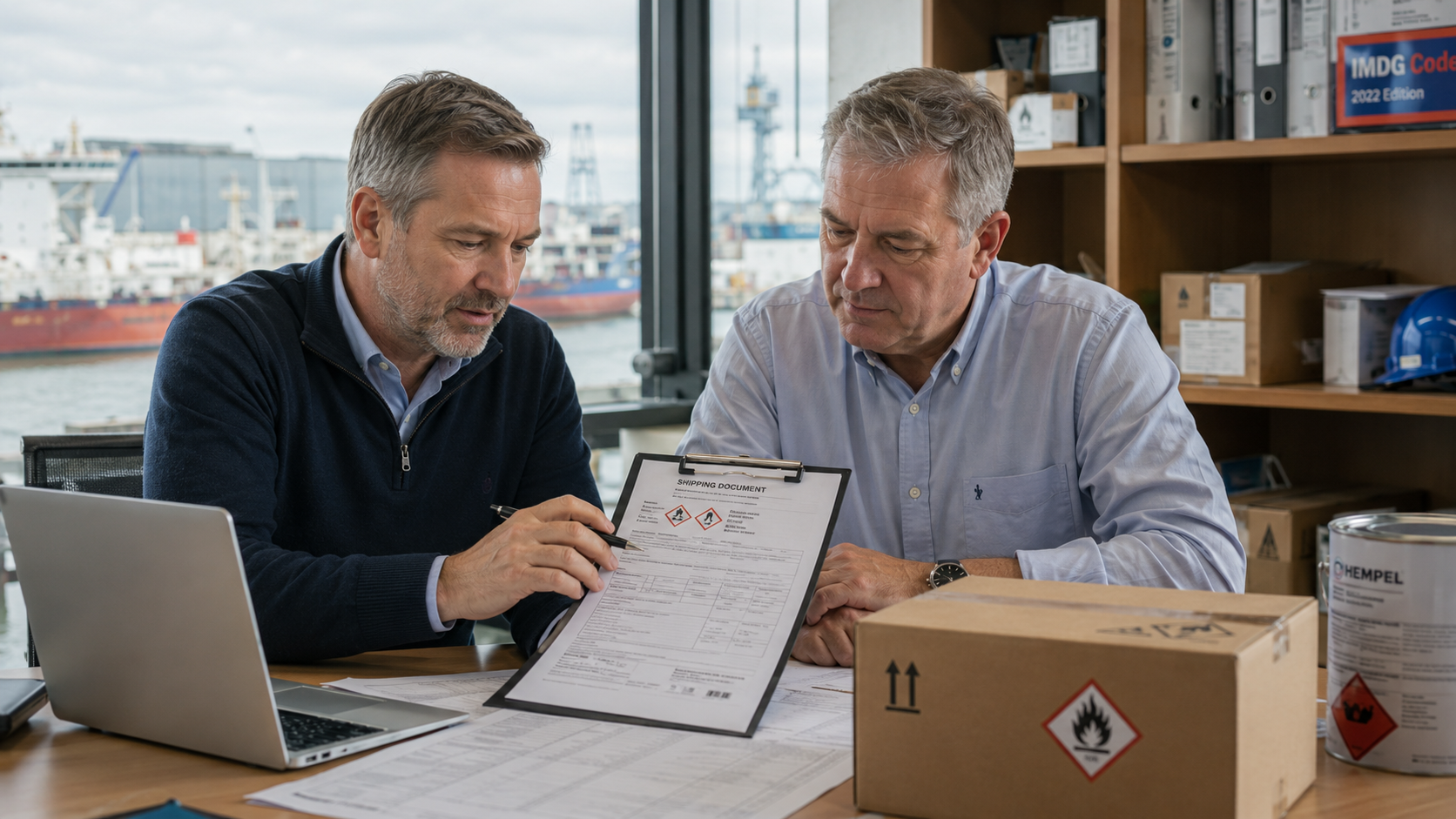
Dangerous Goods in Marine Supply: IMDG Code Essentials for Procurement Teams
Dangerous goods marine supply IMDG compliance is not only a logistics issue. For procurement teams, logistics coordinators and technical buyers, it is an essential part of safe vessel supply planning.
Many marine supply items look ordinary at first glance. Paints, solvents, aerosols, cleaning chemicals, batteries, adhesives, gas cylinders, resins, fuel additives and certain technical stores may all fall under dangerous goods rules depending on their composition, quantity, packaging and transport mode.
This is why procurement teams cannot treat hazardous marine stores like standard ship supply items. Before ordering, they need to understand whether the product is classified as dangerous goods, what documentation is required, whether the supplier can pack and declare it correctly, and whether the carrier can accept it for transport.
At AVS Global Ship Supply & Catering, we support vessel operators with technical stores, marine chemicals, provisions, bonded stores and global ship supply coordination. For chemical supply categories, see Marine Chemicals.
What the IMDG Code Covers and Why It Matters for Buyers
The IMDG Code is the International Maritime Dangerous Goods Code. It provides rules for the safe transport of dangerous goods by sea in packaged form.
For procurement teams, the IMDG Code matters because it affects how certain products must be classified, packed, marked, labelled, documented, loaded, segregated and transported before they can reach the vessel.
A buyer does not need to become a dangerous goods specialist, but they do need to know when a product requires DG handling. If the procurement team misses this point, the shipment may be rejected by the carrier, delayed at port, stopped by authorities or delivered without the correct documentation.
Why Procurement Teams Should Care About IMDG
In marine procurement, dangerous goods issues often appear late in the process. A vessel may urgently request paint, thinner, spray cans, chemicals or batteries, but the buyer may discover only after quotation that the goods need DG packing, a declaration, special transport approval or carrier acceptance.
This can create delays and extra cost.
Procurement teams should check dangerous goods status early because it affects:
- Supplier selection
- Product availability
- Packing requirements
- Lead time
- Freight cost
- Port acceptance
- Carrier acceptance
- Documentation
- Storage before delivery
- Final delivery to the vessel
Dangerous goods compliance should be part of the RFQ stage, not a problem discovered after the purchase order is issued.
IMDG Is Not Only for Logistics Teams
Logistics teams usually manage shipment execution, but procurement teams start the process. They select the supplier, request documents, compare quotations and confirm whether the product can be supplied to the vessel.
If procurement does not ask the right DG questions, logistics may not have enough time to arrange compliant transport.
This is why IMDG Code procurement awareness is important for marine buyers, technical buyers and purchasing officers.
DG Classes Most Common in Ship Supply
The IMDG Code divides dangerous goods into hazard classes. In ship supply, some classes appear more often than others because vessels regularly require chemicals, aerosols, paints, batteries and technical consumables.
Common DG Classes in Marine Supply
Common dangerous goods classes in ship supply may include:
- Class 2: Gases
- Class 3: Flammable liquids
- Class 4: Flammable solids and related substances
- Class 5: Oxidizing substances and organic peroxides
- Class 6: Toxic and infectious substances
- Class 8: Corrosive substances
- Class 9: Miscellaneous dangerous substances and articles
In daily marine procurement, Class 3, Class 8 and Class 9 are especially common because many paints, solvents, cleaners, chemicals, batteries and technical products may fall into these categories.
Examples of DG-Related Ship Supply Items
Dangerous goods may appear in several marine supply categories.
Examples include:
- Marine paints
- Paint thinners
- Solvents
- Degreasers
- Cleaning chemicals
- Aerosol sprays
- Gas cylinders
- Adhesives and sealants
- Resins and hardeners
- Fuel additives
- Water treatment chemicals
- Corrosion inhibitors
- Lithium batteries
- Firefighting-related chemicals
- Certain technical stores and spare parts
Not every product in these categories is automatically dangerous goods. Classification depends on the product’s composition, hazard properties, quantity and shipping information.
For broader technical supply categories, see Technical Stores.
Why Product Category Alone Is Not Enough
A product name is not enough to confirm DG status. Two similar products may have different classifications because their ingredients, flash point, concentration or formulation may be different.
For example, one paint product may be classified as flammable liquid, while another water-based product may not require the same DG handling. One cleaning chemical may be corrosive, while another may be non-hazardous for transport.
This is why buyers should always request the Safety Data Sheet and transport information before assuming whether a product is DG or non-DG.
Packing Groups, UN Numbers and Proper Shipping Names
Dangerous goods identification depends on specific transport information. The most important details for buyers are the UN number, proper shipping name, hazard class and packing group where applicable.
What Is a UN Number?
A UN number is a four-digit identification number assigned to a dangerous substance or article for transport. It helps carriers, suppliers, ports and authorities identify the type of dangerous goods being shipped.
For example, a dangerous goods item may be identified with a UN number, a proper shipping name, a class and a packing group. These details are usually found in the product’s Safety Data Sheet, especially in the transport information section.
Procurement teams should not guess the UN number. It should come from the supplier, manufacturer, SDS or qualified DG documentation source.
Proper Shipping Name
The proper shipping name is the official transport name used for dangerous goods documentation. It is not always the same as the commercial product name.
A product may be sold under a brand name, but the DG declaration must use the correct proper shipping name according to the applicable dangerous goods classification.
This is important because carriers and port authorities rely on the proper shipping name to understand the hazard and apply correct handling rules.
Packing Groups
Packing groups indicate the degree of danger for certain dangerous goods.
They are generally shown as:
- Packing Group I: High danger
- Packing Group II: Medium danger
- Packing Group III: Low danger
Not all dangerous goods have a packing group. However, when a packing group applies, it affects packaging, handling and transport requirements.
For procurement teams, the key point is simple: if a product is DG, the quotation should not only mention price and delivery time. It should also confirm the transport classification details.
What Buyers Should Request Before Ordering
Before purchasing a DG-classified product, buyers should request:
- Product name
- Manufacturer name
- Latest Safety Data Sheet
- UN number
- Proper shipping name
- IMDG class
- Packing group where applicable
- Marine pollutant status where applicable
- Flash point where relevant
- Packaging type
- Net and gross quantity
- Limited quantity or excepted quantity status if applicable
- Supplier confirmation that DG documentation can be provided
This information helps logistics teams plan transport correctly and reduces the risk of shipment rejection.
Marking, Labelling and Placarding Requirements
Dangerous goods must be correctly marked and labelled before transport. This is one of the most visible parts of IMDG compliance.
For procurement teams, marking and labelling should not be treated as a warehouse detail only. If goods are incorrectly marked, the carrier may reject the cargo or authorities may hold the shipment.
Package Marking
Package marking usually identifies the dangerous goods information on the package. Depending on the product and shipment, this may include the UN number, proper shipping name and other required marks.
The mark must be visible, durable and suitable for the transport conditions.
Buyers should confirm that the supplier can provide compliant packaging and marking before the order is finalized.
Hazard Labels
Hazard labels communicate the danger class of the product. These labels help handlers, carriers, warehouse staff and emergency responders understand the risk.
For example, labels may indicate flammable liquid, corrosive substance, gas, oxidizer or miscellaneous dangerous goods.
If the wrong label is used, the shipment may be treated incorrectly. This can create safety, compliance and liability risks.
Placarding for Cargo Transport Units
When dangerous goods are loaded into a cargo transport unit, placarding may be required depending on the shipment type and regulatory requirements.
Procurement teams may not manage placarding directly, but they need to understand that DG shipments often require more coordination than ordinary supply orders.
The supplier, freight forwarder, carrier and logistics coordinator must all have the correct information before movement begins.
Why Marking Errors Cause Delays
Marking and labelling problems can delay delivery even when the product itself is correct.
Common issues include:
- Missing UN number
- Wrong hazard label
- Damaged label
- Incorrect proper shipping name
- Non-compliant packaging
- Missing marine pollutant mark where required
- Mismatch between package label and DG declaration
- Quantity not matching documentation
These errors are avoidable when procurement requests complete DG information early.
Documentation: Multimodal DG Declaration and SDS
Documentation is one of the most important parts of dangerous goods marine supply. A product may be correctly classified and packed, but if the documents are missing or inconsistent, the shipment may still be rejected.
Safety Data Sheet
The Safety Data Sheet, often called SDS, gives information about the product’s hazards, safe handling, storage, emergency measures and transport classification.
For procurement teams, the transport section of the SDS is especially important. It may include information such as UN number, proper shipping name, transport hazard class, packing group, environmental hazards and special precautions.
Buyers should request the latest SDS from the supplier or manufacturer before confirming a dangerous goods order.
Multimodal Dangerous Goods Declaration
The Multimodal Dangerous Goods Declaration is a key document for DG shipments. It communicates the dangerous goods transport information to the carrier and other parties involved in the movement.
The declaration may include:
- Shipper details
- Consignee details
- UN number
- Proper shipping name
- Hazard class
- Packing group
- Number and type of packages
- Quantity
- Marine pollutant status where applicable
- Flash point where required
- Emergency contact or additional handling information where applicable
- Shipper declaration and signature
The exact requirements depend on the shipment and applicable rules, but the core purpose is always the same: to accurately declare what is being transported.
Why SDS and DG Declaration Must Match
The SDS and DG declaration should not contradict each other. If the SDS shows one classification and the declaration shows another, the shipment may be stopped for clarification.
Procurement teams should check for basic consistency before passing documents to logistics.
Important checks include:
- Same product name or identifiable reference
- Correct UN number
- Correct proper shipping name
- Correct hazard class
- Correct packing group where applicable
- Correct quantity
- Correct packaging description
- Marine pollutant status where applicable
If there is any doubt, the supplier or qualified DG specialist should confirm before the shipment is arranged.
Special Cases: Limited Quantities and Excepted Quantities
Not every dangerous goods shipment is handled in the same way. Some products may be shipped under limited quantity or excepted quantity provisions when they meet specific conditions.
These options can simplify certain shipments, but they do not mean the goods are no longer dangerous.
Limited Quantities
Limited quantity provisions may apply when dangerous goods are packed in small quantities that meet the relevant rules. This can affect packaging, marking and documentation requirements.
For procurement teams, limited quantity should never be assumed only because the order is small. The product classification, inner packaging quantity, outer packaging and applicable IMDG provisions must all be checked.
A supplier may say “small quantity,” but that does not automatically mean “limited quantity” under dangerous goods rules.
Excepted Quantities
Excepted quantity provisions apply to very small quantities of certain dangerous goods under strict conditions. These shipments may have different marking and documentation requirements compared with fully regulated DG cargo.
Again, this must be confirmed by classification and applicable rules. Buyers should not decide excepted quantity status based on product size alone.
Why These Cases Matter for Procurement
Limited quantity and excepted quantity status can affect lead time, carrier acceptance, cost and documentation.
Procurement teams should ask suppliers:
- Is this product DG under IMDG?
- Can it be shipped as limited quantity?
- Can it be shipped as excepted quantity?
- What packaging is required?
- What marks or labels are required?
- What documentation will be provided?
- Has the carrier accepted this shipment type before?
These questions help avoid last-minute surprises.
Supplier Responsibilities vs Carrier Responsibilities
Dangerous goods shipments involve several parties. Procurement teams need to understand where supplier responsibility ends and where carrier responsibility begins.
This is important because delays often happen when each party assumes another party is handling the DG requirement.
Supplier Responsibilities
The supplier is usually expected to provide correct product information and prepare the goods properly for transport, depending on the agreed scope.
Supplier responsibilities may include:
- Providing the latest SDS
- Confirming DG classification
- Providing UN number and proper shipping name
- Confirming packing group where applicable
- Packing goods in suitable packaging
- Marking and labelling packages correctly
- Providing DG declaration where agreed
- Confirming quantity and package details
- Advising storage and handling conditions
- Informing the buyer if carrier restrictions may apply
Not all suppliers are capable of handling DG shipments. Procurement teams should confirm capability before issuing the purchase order.
Carrier Responsibilities
The carrier is responsible for accepting and transporting the goods according to applicable requirements. The carrier may check the DG declaration, packaging, labels, stowage requirements and compatibility with other cargo.
Carrier responsibilities may include:
- Reviewing DG documentation
- Confirming cargo acceptance
- Applying stowage and segregation requirements
- Checking transport restrictions
- Coordinating vessel or container acceptance
- Rejecting non-compliant cargo where necessary
A carrier may refuse cargo if documents, packaging or labels are not correct.
Procurement Team Responsibilities
Procurement teams sit between the vessel requirement, supplier and logistics process. Their role is to make sure the right questions are asked early.
Buyers should confirm:
- Whether the requested item is DG
- Whether the supplier can provide SDS and DG documents
- Whether the quoted price includes DG packing
- Whether DG freight cost is included or separate
- Whether the carrier can accept the cargo
- Whether delivery timing is realistic
- Whether storage before delivery is suitable
- Whether the vessel can receive the goods at the planned port
This coordination is especially important for urgent vessel supply, technical stores and marine chemicals.
How AVS Supports Dangerous Goods Marine Supply
AVS supports procurement and technical teams by helping clarify product requirements, sourcing technical stores and marine chemicals, coordinating supplier communication and supporting documentation requests where applicable.
Dangerous goods supply depends on product type, port, supplier capability, carrier acceptance, documentation and local requirements. For DG-classified products or hazardous marine stores, early RFQ details help reduce delays.
For urgent vessel requirements, marine chemicals, technical stores or DG-related supply requests, use Quick Quote.
For pollution prevention and marine compliance topics, see MARPOL.
Conclusion: DG Procurement Needs Early Classification and Clear Documents
Dangerous goods marine supply requires more than finding stock and arranging delivery. Procurement teams must confirm whether the product is DG, request the correct SDS, check UN number and proper shipping name, confirm packaging and marking requirements and coordinate with suppliers and carriers.
The earlier DG status is identified, the easier it becomes to avoid delays, rejected cargo, compliance issues and unsafe handling.
For marine buyers, technical buyers and logistics coordinators, IMDG Code awareness improves procurement planning. It helps teams ask better questions, compare supplier capability more accurately and protect the vessel supply chain from avoidable risk.
AVS Global Ship Supply & Catering supports ship managers, procurement teams and technical departments with marine chemicals, technical stores, provisions, bonded stores and coordinated vessel supply solutions across international ports.
For dangerous goods marine supply, marine chemicals or technical store requests, use Quick Quote.
FAQ
What is the IMDG Code?
The IMDG Code is the International Maritime Dangerous Goods Code. It provides rules for the safe transport of dangerous goods by sea in packaged form, including classification, packing, marking, labelling, documentation, stowage and segregation.
How do I know if a product is dangerous goods?
You can check the product’s Safety Data Sheet, especially the transport information section. The supplier or manufacturer should confirm whether the product is classified as dangerous goods under IMDG or other transport rules.
What is a UN number and where is it found?
A UN number is a four-digit identification number assigned to dangerous goods for transport. It is usually found in the product’s SDS, DG declaration or manufacturer transport information.
Who is responsible for the DG declaration?
Responsibility depends on the shipment arrangement, but the shipper or party offering the goods for transport is usually responsible for accurate dangerous goods declaration. Procurement teams should confirm this clearly with the supplier and logistics provider before shipment.
Are paints and solvents always DG?
No. Many paints and solvents are classified as dangerous goods, especially if they are flammable, but not all products are automatically DG. Classification depends on product formulation, flash point, composition, quantity and transport information.
What is the difference between limited and excepted quantities?
Limited quantities and excepted quantities are special provisions for certain dangerous goods shipped in small amounts under specific conditions. They may reduce some requirements, but they do not mean the goods are non-dangerous.
Can DG be air-freighted to a vessel?
Some dangerous goods can be air-freighted if they meet IATA dangerous goods requirements and carrier restrictions. However, air transport rules are different from IMDG sea transport rules, and many DG items face stricter limits by air.
What SDS information is required for shipping?
For shipping, the SDS should include transport information such as UN number, proper shipping name, hazard class, packing group where applicable, environmental hazards, special precautions and relevant transport classifications.
Do all suppliers handle DG, or only certified ones?
Not all suppliers can handle dangerous goods. DG-capable suppliers should understand classification, packaging, marking, labelling, documentation and storage requirements. Buyers should confirm supplier capability before placing the order.
Does AVS supply DG-classified products?
AVS can support DG-classified product requests depending on product type, port, supplier capability, documentation, carrier acceptance and local requirements. Early RFQ details help confirm feasibility and lead time.
What happens if DG is misdeclared?
Misdeclared dangerous goods can cause cargo rejection, shipment delay, penalties, safety incidents, fire risk, pollution risk and legal liability. Accurate declaration is essential for safe transport.
How are DG goods stored before delivery?
DG goods should be stored according to their hazard class, SDS instructions, segregation requirements, temperature conditions and local regulations. Storage must prevent leaks, ignition, contamination and incompatible product contact.