

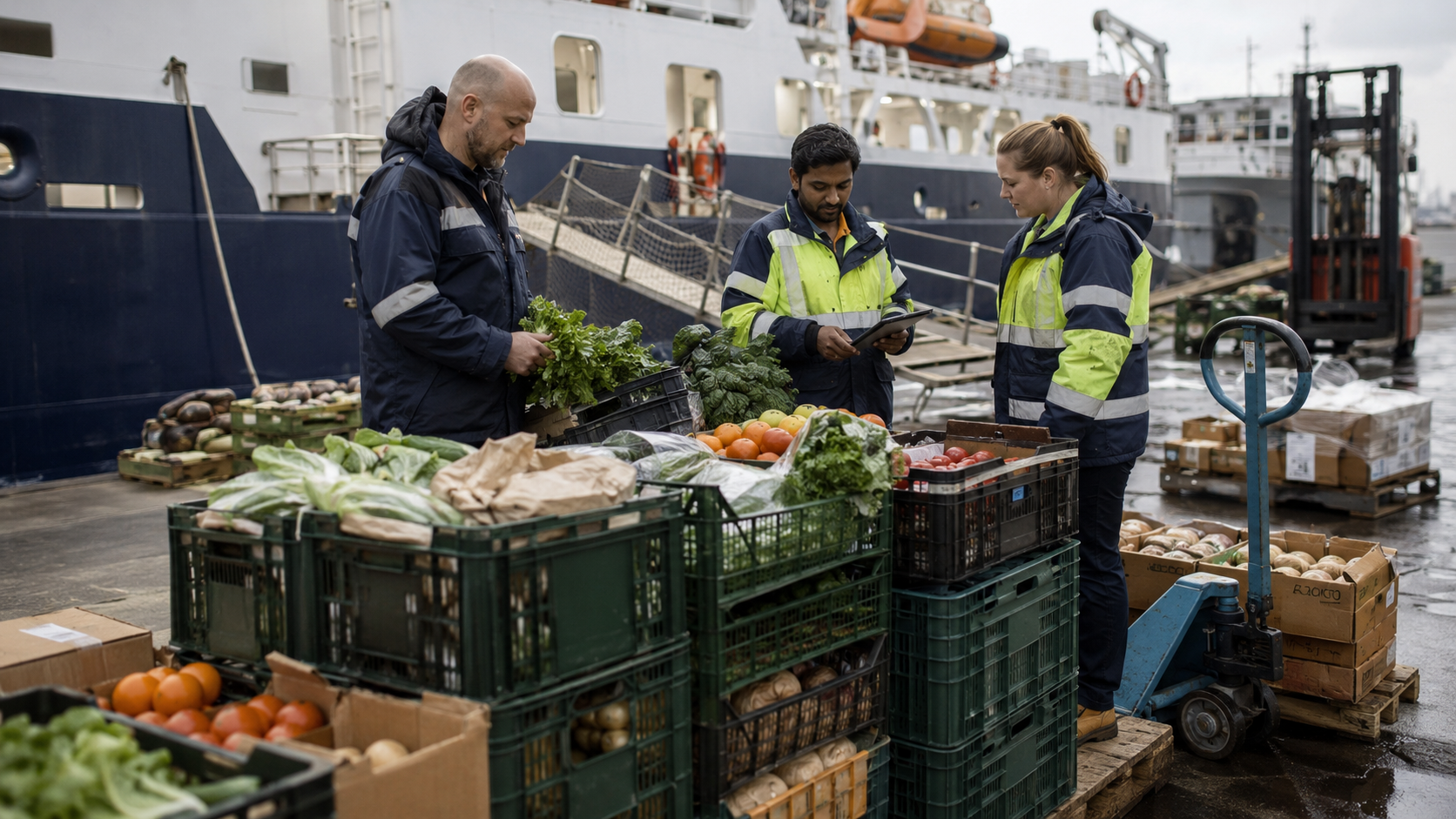
Greener Provisions Sourcing: Reducing Food Miles and Plastic in Ship Supply
Sustainability in ship supply is no longer limited to fuel, waste handling or vessel efficiency. For ship managers, sustainability officers and provisions managers, everyday purchasing decisions also matter. Marine provisions involve food sourcing, packaging, cold chain, transport, storage, waste and crew satisfaction. Each of these areas can influence the environmental footprint of vessel operations.
Sustainable provisions ship supply focuses on reducing unnecessary food miles, lowering plastic packaging, improving menu planning, choosing practical local sourcing options and creating clearer reporting for procurement teams.
A greener provisions strategy does not mean simply buying the “greenest-looking” product or choosing local supply in every port. It means making balanced decisions based on food safety, crew needs, availability, voyage length, packaging, storage, cost, waste risk and operational reliability.
For vessels with multinational crews, the challenge is even more complex. Sustainable sourcing must still respect cultural preferences, dietary needs, quality expectations and MLC 2006 welfare requirements. The goal is not to reduce crew choice, but to build smarter supply plans that reduce avoidable impact without compromising onboard food quality.
AVS Global Ship Supply & Catering supports ship managers, sustainability teams and provisions managers with provisions supply, ESG-aligned procurement support, on/offshore catering and global ship supply coordination across international ports.
For greener provisions planning and vessel supply support, visit Provisions Supply, read more about ESG in Maritime Procurement, explore On & Offshore or submit your request through Quick Quote.
Food Miles in Marine Provisions: Why It Adds Up
Food miles refer to the distance food travels from its point of production, processing or distribution to the final delivery point. In ship supply, this distance can add up quickly because vessels operate across multiple ports, countries and climate zones.
A single provisions order may involve imported produce, regional distribution centers, cold storage, airport or road freight, port delivery and last-mile movement to the vessel. Even when the final delivery distance looks short, the product may have travelled a long route before reaching the supply port.
Why Food Miles Matter in Ship Supply
Food miles matter because transport usually involves fuel, refrigeration, packaging and handling. For provisions managers, reducing unnecessary movement can support lower emissions, lower packaging waste and better freshness when managed correctly.
In marine provisions, food miles can be affected by:
- Product origin
- Import route
- Distribution center location
- Cold chain requirements
- Delivery port
- Vessel schedule
- Supplier network
- Consolidation options
- Seasonality
- Shelf life
- Rejection and replacement risk
A product that travels long distances and then spoils onboard has a higher practical footprint than a product that is sourced closer, delivered fresher and consumed on time.
Food Miles Are Not the Only Sustainability Metric
Food miles should not be treated as the only sustainability factor. A local product may still have a high footprint if it requires energy-intensive storage, inefficient transport, excessive packaging or repeated failed deliveries.
Likewise, an imported item may be more practical if it is shipped in bulk, has a longer shelf life, reduces spoilage and meets crew requirements more reliably.
A balanced approach considers:
- Distance travelled
- Mode of transport
- Cold chain intensity
- Product durability
- Packaging level
- Waste risk
- Crew acceptance
- Supplier reliability
- Cost and availability
- Food safety
The best decision is not always the shortest route. It is the route that delivers safe, suitable provisions with the lowest avoidable waste and operational risk.
Local vs Global Sourcing Trade-Offs
Local sourcing can reduce food miles, support regional suppliers and improve freshness. However, local sourcing is not automatically greener in every situation. Vessel supply depends on timing, port infrastructure, product availability, customs conditions, quality consistency and cold chain capability.
For provisions buyers, the question should not be “local or global?” The better question is: “Which sourcing option provides the best balance of sustainability, quality, availability and operational reliability for this vessel?”
When Local Sourcing Works Well
Local sourcing can be effective when the port has reliable markets, strong supplier coverage and suitable product quality.
It often works well for:
- Fresh vegetables
- Fresh fruits
- Bread and bakery
- Eggs
- Some dairy products
- Bottled water alternatives where safe options exist
- Local seasonal produce
- Selected dry goods
- Certain fish or seafood products where quality controls are strong
Local sourcing may reduce transport distance and improve freshness, especially for short-shelf-life items.
When Global or Regional Sourcing May Be Better
Global or regional sourcing may be more suitable when the vessel needs standardized quality, certified products, specific dietary items or products not available locally.
This may apply to:
- Halal-certified products in ports with limited availability
- Kosher products
- Specialized medical diet items
- Long-life dairy
- Specific brands required by the ship manager
- Frozen proteins
- Dry stores
- Products requiring strict quality consistency
- Items needed across multiple vessels or ports
A global sourcing approach can also support consistency for fleet-wide purchasing and menu planning.
The Risk of Poor Local Substitution
Local sourcing becomes risky when substitutes do not match crew needs or quality expectations. A local supplier may offer an alternative product, but it may not be acceptable for the vessel’s menu plan, cultural requirements or storage conditions.
Poor substitutions can create:
- Crew dissatisfaction
- Higher food waste
- Reordering needs
- Last-minute courier costs
- Quality claims
- Additional packaging and transport
- Lower confidence in green sourcing programs
For local sourcing to work, substitutions must be controlled through clear specifications.
Practical Sourcing Decision Criteria
Before choosing local, regional or global sourcing, buyers should compare:
- Product availability in the supply port
- Quality and grade consistency
- Shelf life
- Crew preference
- Storage capacity
- Certification requirements
- Packaging impact
- Transport distance
- Cold chain needs
- Waste risk
- Total delivered cost
- Reporting needs
Greener provisions sourcing works best when procurement teams make decisions item by item, not by applying one rule to every category.
Plastic Packaging Reduction in Provisions
Plastic packaging is common in ship supply because it protects food, supports hygiene, extends shelf life and helps products survive transport. However, excessive plastic creates waste onboard and increases disposal pressure for vessels.
The goal is not to remove all packaging. The goal is to reduce unnecessary plastic while maintaining food safety, shelf life and handling quality.
Where Plastic Appears in Provisions Supply
Plastic packaging may appear in:
- Shrink-wrapped pallets
- Single-use produce bags
- Plastic trays
- Plastic bottles
- Film-wrapped dairy products
- Individually packed snacks
- Frozen product wrapping
- Sachets and small portion packs
- Plastic liners
- Secondary transport packaging
Some plastic has a protective role. Other packaging is added for retail display or convenience and may be reduced for vessel supply.
How Buyers Can Specify Lower-Plastic Options
Plastic reduction starts with the RFQ and purchase order. If buyers do not specify packaging expectations, suppliers may default to standard packaging.
Buyers can request:
- Reduced secondary packaging
- Bulk packs instead of small individual packs
- Recyclable packaging where practical
- Cardboard cartons instead of plastic trays where suitable
- Returnable crates for selected categories
- No unnecessary retail display packaging
- Larger format condiments instead of single sachets
- Refill options for galley products
- Consolidated delivery packaging
- Clear separation of food safety packaging and avoidable packaging
The supplier should know which packaging can be reduced and which packaging must remain for hygiene or shelf-life reasons.
Avoiding False Plastic Reduction
Plastic reduction should not create more food waste. Removing protective packaging from fresh produce may look greener at delivery, but if it reduces shelf life and increases spoilage, the total impact may be worse.
A practical plastic reduction strategy should protect:
- Food safety
- Cold chain
- Shelf life
- Product integrity
- Crew hygiene
- Storage efficiency
- Waste sorting
- Port compliance
Greener provisions sourcing is not about cosmetic changes. It is about reducing avoidable plastic without increasing spoilage or operational risk.
Reusable Crates and Pallet Programs
Reusable crates and pallet programs can reduce single-use packaging in marine logistics, especially for recurring provisions supply in ports with reliable supplier relationships. However, they require planning, tracking and a realistic return process.
A reusable crate only supports sustainability if it is actually reused enough times and does not create inefficient return transport.
When Reusable Crates Are Feasible
Reusable crates can work well when:
- The vessel calls the same port regularly
- Supplier and vessel have a repeat supply relationship
- Port agent can coordinate returns
- Crates are durable and stackable
- Crates can be cleaned properly
- Storage space is available
- Return timing is predictable
- The system is tracked
- Loss and damage are managed
This model is especially useful for fresh produce, bakery items and selected dry provisions.
When Reusable Crates Are Difficult
Reusable crates may be less practical when:
- Vessel calls are irregular
- The vessel will not return to the same port
- Crate return is more complex than the delivery
- Port access is limited
- Cleaning responsibility is unclear
- Crates may be lost onboard
- The supplier cannot track assets
- Return transport creates more impact than single-use packaging reduction
For tramp shipping, one-off calls or remote ports, reusable crates may need to be evaluated carefully.
Pallet Programs and Consolidation
Pallet programs can help reduce handling, improve loading efficiency and support better delivery control. They may also reduce repeated small deliveries.
A greener pallet strategy may include:
- Consolidated orders
- Reusable pallets where feasible
- Correct pallet sizing
- Reduced stretch film
- Better load stability
- Clear delivery sequencing
- Return or exchange system where practical
- Avoiding half-empty deliveries
Consolidation can reduce emissions and packaging when planned early. Last-minute ordering often creates more trips, more packaging and higher cost.
Seasonal Menus and Crew Feedback
Seasonal menu planning is one of the most practical ways to support sustainable provisions. Seasonal products are often fresher, more available and easier to source locally or regionally.
For vessels, seasonal menus must still be practical. The menu should match crew preferences, galley capability, storage conditions and voyage length.
Why Seasonal Menus Help
Seasonal menus can support sustainability by:
- Reducing reliance on long-distance imported fresh items
- Improving freshness
- Lowering spoilage risk
- Supporting local or regional sourcing
- Reducing cost volatility
- Improving menu variety
- Allowing better product substitutions
- Supporting crew satisfaction with better-quality produce
For example, requesting seasonal vegetables available in the supply region may be more practical than insisting on imported out-of-season items.
Crew Feedback Matters
Crew feedback is an important part of sustainable provisions planning. Food that is technically “green” but unpopular can lead to waste.
Feedback can help identify:
- Items frequently wasted
- Preferred staple foods
- Better accepted vegetarian options
- Cultural food preferences
- Products with poor shelf life onboard
- Items that should be purchased frozen instead of fresh
- Products that should be replaced by seasonal alternatives
Sustainability improves when provisions are actually consumed, not just delivered.
Vegetarian and Plant-Forward Menus
Vegetarian or plant-forward menu options may reduce the environmental impact of provisions, but they must be planned properly. A vessel cannot simply reduce meat without replacing nutrition and crew satisfaction.
A practical plant-forward approach may include:
- Lentils
- Beans
- Chickpeas
- Rice and grains
- Vegetables
- Nuts and seeds
- Eggs and dairy where suitable
- Plant-based proteins where available
- Culturally familiar vegetarian dishes
- Balanced menu cycles
For multinational crews, vegetarian options should reflect real eating habits, not generic substitutes.
Reporting and KPIs for Sustainable Provisions
Sustainable provisions programs need clear reporting. Without data, it is difficult to show progress, compare suppliers or defend procurement decisions.
Reporting does not need to be overly complex at the beginning. A simple, consistent KPI set can help ship managers track improvement over time.
Useful KPIs for Sustainable Provisions
Sustainability officers and provisions managers may track:
- Local sourcing percentage
- Regional sourcing percentage
- Estimated food miles by category
- Plastic packaging reduction
- Reusable crate usage
- Consolidated delivery rate
- Fresh produce rejection rate
- Spoilage or waste feedback
- Frozen vs fresh balance
- Seasonal item usage
- Vegetarian menu adoption
- Supplier ESG documentation
- Delivery consolidation performance
- Claims related to quality or packaging
The most useful KPIs are practical and repeatable. They should support better decisions, not create unnecessary reporting workload.
Can Emissions from Provisions Be Reported?
Emissions from provisions can be estimated when enough data is available. A practical report may use product category, origin, transport mode, delivery distance and cold chain information.
However, reporting should be transparent about assumptions. For many marine provisions movements, exact emissions may be difficult to calculate because products pass through several suppliers and distribution points.
A practical approach may report:
- Known origin where available
- Local vs imported split
- Transport mode where known
- Estimated delivery distance
- Cold chain requirement
- Packaging type
- Waste or rejection feedback
- Supplier ESG notes
This gives procurement teams a workable starting point.
ESG Audit Support
For ESG or supplier audits, provisions sourcing may be reviewed through:
- Supplier records
- Product origin
- Packaging specifications
- Delivery documents
- Waste reduction initiatives
- Reusable packaging programs
- Food safety documentation
- Crew feedback
- Claims history
- Corrective actions
- Supplier ESG policies
A strong audit trail helps ship managers show that sustainable provisions sourcing is not only a marketing claim, but a controlled procurement practice.
How AVS Supports Greener Provisions Sourcing
AVS supports ship managers, sustainability officers and provisions managers with practical greener sourcing options across international ports.
AVS can support:
- Provisions supply planning
- Local and regional sourcing review
- Seasonal product alternatives
- Plastic packaging reduction discussions
- Reusable crate feasibility review
- Fresh, frozen and dry provisions planning
- Multicultural crew menu support
- Supplier coordination
- ESG-related procurement documentation
- On/offshore catering support
- Global ship supply coordination
- RFQ and delivery planning
A greener provisions strategy must still work operationally. AVS helps balance sustainability goals with crew welfare, vessel schedules, food safety and port availability.
For sustainable provisions supply requests, submit your inquiry through Quick Quote.
Conclusion: Greener Provisions Must Be Practical
Greener provisions sourcing is not about one simple rule. It is about reducing avoidable food miles, limiting unnecessary plastic, improving packaging choices, planning seasonal menus and creating better reporting without compromising food safety or crew welfare.
Local sourcing can help, but it must be balanced with quality, availability, cold chain and crew requirements. Plastic reduction is valuable, but it must not increase spoilage. Reusable crates can work, but only when the return process is realistic.
The most effective sustainable provisions strategies are practical, measurable and crew-focused. They reduce waste, support better supplier decisions and help ship managers align everyday procurement with wider ESG goals.
AVS Global Ship Supply & Catering supports provisions supply, marine provisions, ESG-aware procurement and on/offshore catering support across international ports.
FAQ
What are food miles in ship supply?
Food miles in ship supply refer to the distance food travels from production, processing or distribution to final delivery at the vessel. In marine provisions, this may include import routes, cold storage, road transport, port delivery and last-mile movement.
Is local sourcing always greener?
No. Local sourcing can reduce distance, but it is not always greener. Product quality, cold chain, transport efficiency, seasonality, waste risk and availability must also be considered.
How can plastic packaging be reduced?
Plastic packaging can be reduced by specifying bulk packs, reducing secondary packaging, using reusable crates where feasible, avoiding unnecessary retail packaging and choosing recyclable options when practical.
Are reusable crates feasible in marine logistics?
Reusable crates are feasible when there is a reliable return process, repeat port calls, supplier tracking, cleaning arrangements and enough storage space. They are less practical for one-off or irregular vessel calls.
Does crew prefer fresh or frozen long-term?
Crew generally values fresh items, but frozen products are important for longer voyages, backup stock and ports with limited fresh availability. The best plan usually combines fresh, frozen and dry provisions.
How do seasonal menus help sustainability?
Seasonal menus can reduce reliance on long-distance imported products, improve freshness, lower spoilage risk and support local or regional sourcing where available.
Can AVS report on emissions from provisions?
AVS can support practical reporting inputs such as sourcing location, local vs imported split, delivery route, packaging choices and supplier documentation. Exact emissions reporting depends on available data and agreed methodology.
Do organic products fit on vessels?
Organic products can fit vessel provisions when availability, shelf life, certification, price and crew acceptance are suitable. They should be evaluated by category and port rather than applied as a blanket rule.
How does cold chain affect food miles?
Cold chain affects sustainability because refrigerated storage and transport require energy. A product with long transport distance and intensive cold chain may carry higher impact than a durable or locally sourced alternative.
What is the cost premium for green provisions?
The cost premium depends on product category, port, season, packaging choice, certification needs, supplier availability and delivery complexity. Some greener choices may cost more, while others reduce waste and total cost.
Are vegetarian menus more sustainable?
Vegetarian or plant-forward menus can reduce environmental impact, but they must be nutritionally balanced, culturally acceptable and practical for the galley. Crew acceptance is important to avoid waste.
How are provisions audited for ESG?
Provisions can be audited through supplier records, product origin, packaging specifications, delivery documents, food safety documentation, waste reduction initiatives, crew feedback and supplier ESG policies.