

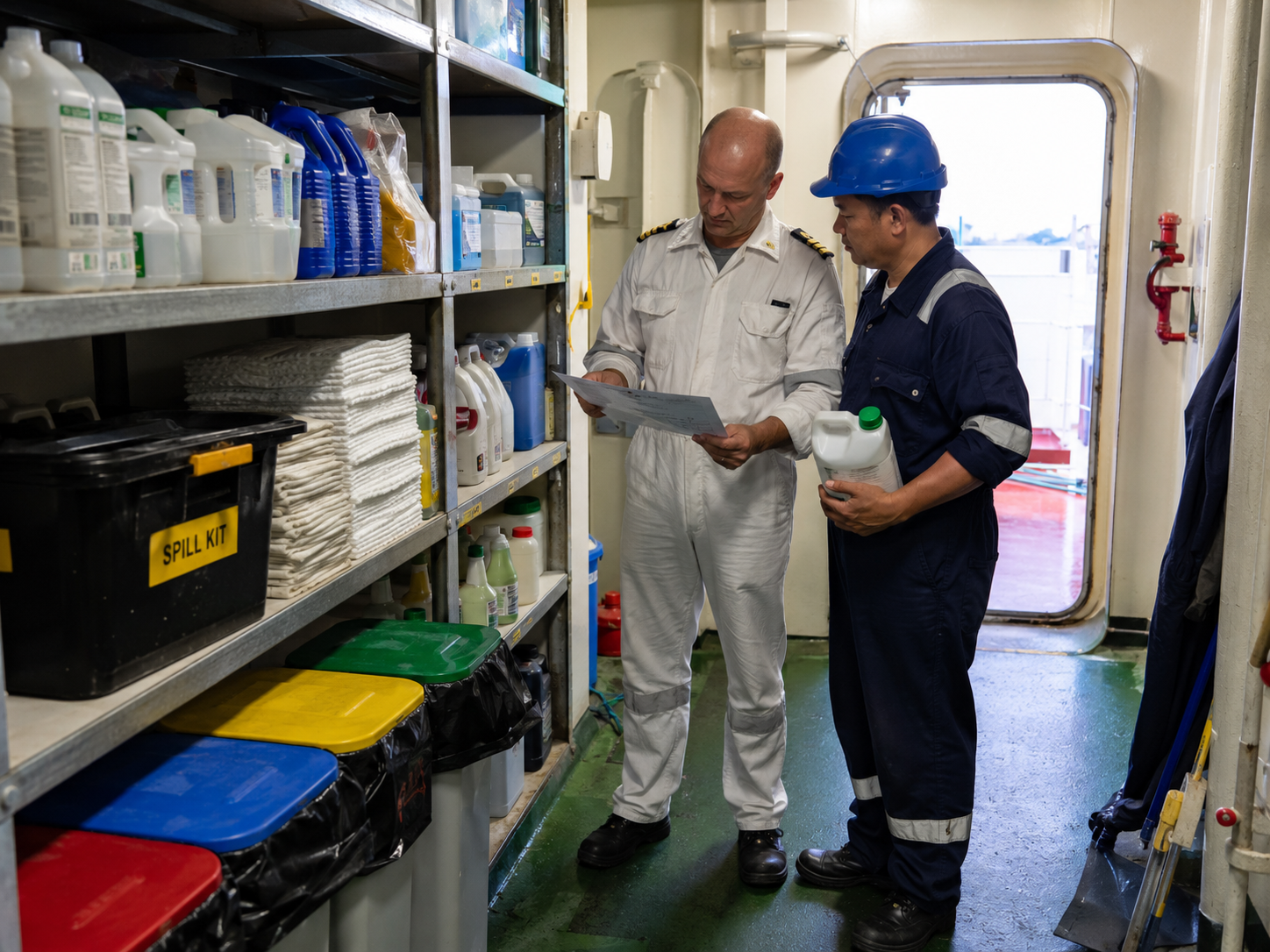
Cleaning Chemicals for Vessels: Procurement and Compliance with MARPOL Annex V
Cleaning chemicals are used every day onboard vessels, but they should not be treated as ordinary consumables. The wrong cleaner can damage coatings, create crew safety risks, contaminate cargo areas, complicate waste handling or create compliance problems under MARPOL requirements.
For technical buyers, HSEQ teams and chief officers, marine cleaning chemicals procurement MARPOL is about selecting products that are effective, documented, safe to handle and suitable for the vessel’s operating environment.
A vessel may need hold cleaning chemicals, tank cleaning chemicals, deck cleaners, degreasers, galley cleaners, cabin hygiene products, multipurpose detergents, descalers, disinfectants, bilge area cleaners and spill response products. Each category has different documentation, storage, compatibility and disposal considerations.
AVS Global Ship Supply & Catering supports ship owners, ship managers, technical buyers and HSEQ teams with marine chemicals, technical stores, deck consumables, cleaning chemicals and vessel supply coordination across international ports.
For regulatory context, see MARPOL. For cleaning chemical, detergent and vessel maintenance supply requests, submit your requirement through Quick Quote.
Categories of Marine Cleaning Chemicals
Marine cleaning chemicals are used in different areas of the vessel. A product that works well in a galley may not be suitable for cargo hold cleaning. A deck degreaser may not be appropriate for tank cleaning. This is why procurement teams should separate cleaning chemicals by application before requesting a quote.
Cargo Hold Cleaning Chemicals
Hold cleaning chemicals are used to remove cargo residues, dust, stains, grease, mineral deposits or contamination from cargo holds. They are especially relevant for bulk carriers that change cargo type between voyages.
Common hold cleaning chemical types include:
- Alkaline hold cleaners
- Acidic cleaners for mineral deposits
- Cement and lime removers
- Grain residue cleaners
- Coal and petcoke residue cleaners
- Degreasers
- Rust stain removers
- Odour control products
- General hold wash detergents
When requesting hold cleaning chemicals, buyers should specify the previous cargo, next cargo, hold coating type and cleaning objective.
Tank Cleaning Chemicals
Tank cleaning chemicals are used for cargo tanks, fuel-related spaces, chemical tankers, product tankers and other vessel areas where residues must be removed before inspection, repair or cargo change.
Tank cleaning requirements may depend on:
- Previous cargo
- Next cargo
- Tank coating
- Residue type
- Temperature requirement
- Cleaning method
- Ventilation needs
- Toxicity and flammability concerns
- Waste reception arrangement
- SDS and compatibility documentation
Tank cleaning products require careful technical review because they may be linked to cargo compatibility, enclosed space safety and waste handling procedures.
Deck, Engine Room and General Cleaners
Deck and machinery space cleaning products support daily vessel maintenance. They may include detergents, degreasers, oil removers, descalers, rust removers and multipurpose cleaners.
Common categories include:
- Deck wash detergents
- Engine room degreasers
- Bilge area cleaners
- Metal cleaners
- Descalers
- Rust stain removers
- Paint-safe detergents
- Non-slip surface cleaners
- Spill cleanup products
These products should be selected with coating compatibility, crew exposure, slip risk and waste handling in mind.
Galley, Cabin and Accommodation Cleaners
Galley and accommodation cleaning chemicals are used for hygiene, food preparation areas, cabins, laundry, bathrooms and common spaces. These products are closer to crew welfare and food hygiene management than heavy-duty cargo cleaning.
Typical categories include:
- Galley degreasers
- Dishwashing liquids
- Surface cleaners
- Disinfectants
- Floor cleaners
- Toilet cleaners
- Glass cleaners
- Laundry detergents
- Odour control products
- General-purpose cleaning sprays
For food preparation areas, product selection should support hygiene procedures. For broader food safety context, buyers may also review HACCP and ISO 22000.
Why Category Separation Matters
A vague RFQ such as “cleaning chemical” often leads to wrong quotations. Suppliers need the application, surface, residue type and documentation expectation to quote accurately.
A strong RFQ should include:
- Vessel name
- Product category
- Cleaning application
- Surface or tank type
- Previous cargo where relevant
- Next cargo where relevant
- Required quantity
- Packaging preference
- SDS requirement
- Delivery port
- ETA and delivery window
- Required certificates or declarations
- Crew safety requirements
- Disposal or waste handling considerations
This structure improves quotation accuracy and reduces unsuitable substitutions.
Hold and Tank Cleaning Specifications
Hold and tank cleaning chemicals should be procured with more technical detail than general-purpose cleaners. The wrong product can damage coatings, leave residues, fail inspection or create safety hazards.
Hold Cleaning: Previous Cargo and Next Cargo
For cargo holds, the previous and next cargo are essential. A cleaner suitable after coal may not be the best choice after cement, grain, sulphur, petcoke, fertilizer or mineral cargo.
The RFQ should state:
- Previous cargo
- Next cargo
- Hold condition
- Cargo residue type
- Coating type
- Cleaning target
- Available cleaning equipment
- Fresh water availability
- Time available before inspection
- Required documentation
- Waste handling expectation
If the next cargo is sensitive, cleaning standards may be stricter.
Tank Cleaning: Cargo and Safety Requirements
Tank cleaning chemical selection should consider cargo properties, residue behaviour and crew safety. Some residues may create flammable vapours, toxic exposure or chemical reaction risks.
Tank cleaning RFQs should include:
- Previous cargo
- Next cargo
- Tank coating
- Residue type
- Cleaning temperature
- Circulation or manual cleaning method
- Gas-freeing requirements
- Enclosed space entry considerations
- Waste reception arrangement
- Required SDS
- PPE requirements
- Compatibility restrictions
Chief officers, chief engineers and HSEQ teams should coordinate before approving tank cleaning chemicals.
Coating and Material Compatibility
Some cleaning chemicals can damage epoxy coatings, zinc silicate coatings, aluminium, rubber seals, painted surfaces, stainless steel, brass, copper or plastic components.
Buyers should ask for:
- Product Technical Data Sheet
- Safety Data Sheet
- Dilution instructions
- Surface compatibility information
- pH value
- Application method
- Contact time
- Rinse requirement
- Temperature limits
- Manufacturer restrictions
If coating damage occurs, the cost can be much higher than the cleaning chemical price.
Documentation for Hold and Tank Cleaning Chemicals
Depending on product type and vessel procedure, documentation may include:
- Safety Data Sheet
- Technical Data Sheet
- Product certificate
- Batch information
- Manufacturer declaration
- IMO/MARPOL-related statement where applicable
- HME declaration where relevant
- Delivery note
- Packing list
- Proof of delivery
- Handling instructions
Documentation should be requested before delivery, not after the vessel has already started cleaning.
Galley, Cabin and General-Purpose Cleaners
Galley, cabin and general-purpose cleaners are used more frequently than cargo cleaning chemicals. Because they are handled by crew in daily routines, safety, labelling, dilution and storage are especially important.
Galley Cleaning Products
Galley cleaning products should remove grease, food residues and surface contamination without creating unnecessary crew exposure or residue risk on food-contact areas.
Common galley products include:
- Food-area surface cleaners
- Degreasers
- Dishwashing liquids
- Dishwasher detergents
- Descalers
- Floor cleaners
- Waste bin cleaners
- Odour control products
For galley use, buyers should confirm whether the product is suitable for food preparation areas and whether rinsing is required.
Cabin and Accommodation Cleaning
Accommodation cleaners support crew welfare and daily hygiene. These products should be easy to use, clearly labelled and safe when used according to instructions.
Common accommodation cleaning products include:
- Bathroom cleaners
- Toilet cleaners
- Floor detergents
- Glass cleaners
- Laundry detergents
- Disinfectants
- Multipurpose cleaners
- Odour control products
Strong fragrance, poor ventilation or incorrect dilution may affect crew comfort, so procurement should consider usability as well as price.
Disinfectants and Sanitizers
Disinfectants should be selected carefully because they may have specific contact time, dilution, storage and hazard requirements.
Before buying disinfectants, confirm:
- Intended use
- Surface compatibility
- Required dilution
- Contact time
- Active ingredient
- SDS availability
- PPE requirement
- Storage temperature
- Expiry or shelf-life
- Local approval requirement where applicable
Not every cleaning product is a disinfectant. The product claim should match the intended use.
General-Purpose Cleaners
General-purpose cleaners are useful for routine cleaning, but they should not replace specialized products when the application requires a specific chemical.
A general-purpose cleaner may be suitable for:
- Light dirt
- Accommodation areas
- Routine deck cleaning
- Non-critical surfaces
- General maintenance cleaning
It may not be suitable for:
- Heavy cargo residues
- Tank cleaning
- Oil-contaminated spaces
- Scale removal
- Disinfection
- Sensitive coated surfaces
- Food contact areas without proper rinsing instructions
Procurement teams should define the use case clearly.
MARPOL Annex V and Garbage Management
MARPOL Annex V addresses prevention of pollution by garbage from ships. It generally prohibits the discharge of garbage into the sea, except under limited circumstances defined in the Annex.
For vessel cleaning chemicals, the key issue is how cleaning agents, additives and residues in wash water are handled.
Why MARPOL Annex V Matters for Cleaning Chemicals
Cleaning operations may produce wash water containing:
- Cleaning agents
- Additives
- Cargo residues
- Dirt and dust
- Oil or grease traces
- Chemical residues
- Food-related residues
- Packaging waste
- Rags or absorbents
Depending on the cleaning operation, disposal may involve shipboard procedures, reception facilities, garbage management plans, cargo residue rules or other pollution prevention requirements.
Cleaning chemical procurement should therefore consider not only product performance but also environmental classification and waste handling.
Cleaning Agents and Additives in Wash Water
Under MARPOL Annex V, cleaning agents or additives in wash water must be assessed carefully, especially when cargo residues or external surface wash water are involved.
Buyers and HSEQ teams should check whether the product:
- Is harmful to the marine environment
- Contains substances of concern
- Has a clear SDS
- Has manufacturer environmental information
- Is suitable for shipboard use
- Requires special waste handling
- Can be used in the intended cleaning operation
- Has restrictions in special areas
- Creates residues that must be landed ashore
This is especially important for cargo hold washing and deck wash operations.
Cargo Residues and HME Classification
Cargo residues may be classified as harmful to the marine environment depending on the cargo and applicable criteria. If harmful residues are present, discharge rules become stricter.
For hold cleaning, procurement teams should coordinate with vessel staff to confirm:
- Previous cargo classification
- Whether residues are HME
- Whether reception facilities are needed
- Whether the cleaner is suitable
- Whether wash water can be discharged or must be retained
- Whether cargo documentation supports the decision
The cleaning chemical supplier may provide product information, but the vessel operator remains responsible for correct onboard compliance decisions.
Garbage Management Plan and Recordkeeping
Cleaning chemical procurement should align with the vessel’s garbage management procedures.
Records may include:
- Product delivery documents
- SDS
- Cleaning operation records
- Waste landing receipts
- Garbage Record Book entries where applicable
- Cargo residue documentation
- Spill response records
- Disposal instructions
- Crew training records
A well-documented cleaning process supports HSEQ review and port inspection readiness.
Storage, Compatibility and Crew Safety
Cleaning chemicals must be stored and handled correctly onboard. Poor storage can lead to leakage, reaction, label loss, crew exposure or product failure.
Safe Onboard Storage
Cleaning chemicals should be stored in designated areas with clear labels and secure packaging. Incompatible products should not be stored together.
Good storage practices include:
- Keeping original labels visible
- Separating acids and alkalis
- Separating oxidizers from incompatible products
- Keeping flammable products away from ignition sources
- Using spill trays where needed
- Avoiding heat and direct sunlight
- Closing containers after use
- Keeping SDS accessible
- Marking opened containers
- Checking expiry dates where relevant
- Preventing unauthorized mixing
Storage rules should follow the product SDS and vessel procedures.
Chemical Compatibility
Some cleaning chemicals can react dangerously when mixed. For example, acid-based cleaners, chlorine-based products, ammonia-based products and strong alkalis should be managed carefully.
Crew should avoid:
- Mixing products without instruction
- Using unlabelled containers
- Transferring chemicals into food containers
- Reusing containers for other chemicals
- Combining products to “make them stronger”
- Using incorrect dilution
- Applying chemicals to incompatible surfaces
Clear labelling and crew training are essential.
PPE for Handling Cleaning Chemicals
The required PPE depends on the product and task. The SDS should always be the main reference.
Typical PPE may include:
- Chemical-resistant gloves
- Eye protection
- Face shield
- Protective clothing
- Apron
- Safety boots
- Respiratory protection where required
- Ventilation support
- Emergency eyewash access
For stronger tank cleaners, degreasers, acids or caustic products, PPE requirements may be stricter.
Spill Response Onboard
Spill response should be planned before chemicals are used.
A practical response plan should include:
- Stop the leak if safe
- Isolate the area
- Wear correct PPE
- Prevent entry to drains or sea
- Use compatible absorbents
- Collect waste safely
- Follow SDS instructions
- Report according to vessel procedure
- Record the incident
- Land waste ashore where required
Spill kits and absorbents are part of effective chemical safety management.
Greener Chemistry: Green Seal, EcoLabels and Bio-Surfactants
Many buyers now ask for lower-impact cleaning chemicals. However, “green”, “eco-friendly” or “biodegradable” claims should be reviewed carefully. Procurement teams should look for credible information, not marketing language alone.
What Greener Cleaning Means
Greener cleaning products may aim to reduce:
- Aquatic toxicity
- Persistent ingredients
- VOC emissions
- Harsh solvents
- Hazardous substances
- Packaging waste
- Skin and respiratory irritation
- Environmental impact after use
However, a greener product must still perform properly. A weak cleaner may require repeated application, higher dosage or longer cleaning time, which can reduce the practical environmental benefit.
Green Seal and EcoLabels
Green Seal and other ecolabels can help buyers identify products that meet defined environmental and health-related criteria. These labels may consider factors such as ingredients, toxicity, biodegradability, packaging and product performance.
Procurement teams should check:
- Which ecolabel applies
- Whether the product is actually certified
- Whether the certification covers the intended use
- Whether the product is suitable for marine conditions
- Whether SDS and technical documents are available
- Whether performance is proven for the required cleaning task
Ecolabels can support decision-making, but they do not replace technical suitability review.
Bio-Surfactants and Lower-Impact Formulations
Surfactants are key ingredients in many detergents and cleaners. Bio-surfactants or bio-based surfactants may reduce reliance on petroleum-derived ingredients and support lower-impact cleaning formulations.
When reviewing bio-surfactant products, buyers should check:
- Cleaning performance
- Compatibility with surface and residue
- Biodegradability information
- Aquatic toxicity data
- SDS
- Storage stability
- Dilution ratio
- Cost per use
- Packaging type
- Supplier reliability
A green product should be both environmentally preferable and operationally effective.
Avoiding Greenwashing
Greenwashing occurs when environmental claims are vague, exaggerated or unsupported.
Buyers should be cautious with claims such as:
- “Eco”
- “Natural”
- “Non-toxic”
- “Marine safe”
- “Biodegradable”
- “Green cleaner”
- “Environmentally friendly”
These claims should be supported with documentation, test data or recognized certification.
Procurement Pitfalls in Vessel Cleaning Chemicals
Cleaning chemicals are frequently reordered, which can make teams rely too heavily on old purchase records. But product names, formulations, regulations, vessel routes and cleaning requirements can change.
Common Mistakes
Common procurement mistakes include:
- Ordering by generic description only
- Not identifying the cleaning application
- Missing SDS
- Ignoring MARPOL relevance
- Not checking hold or tank coating compatibility
- Buying harsh chemicals for routine cleaning
- Accepting unsuitable substitutes
- Ignoring PPE requirements
- Not confirming packaging size
- Not checking expiry or shelf life
- Missing dilution instructions
- Not checking storage compatibility
- Not confirming whether product is suitable for galley use
- Relying only on “eco-friendly” claims
- Not coordinating with chief officer or HSEQ team
These mistakes can create operational, safety and compliance problems.
What a Strong Cleaning Chemical RFQ Should Include
A strong RFQ should include:
- Vessel name
- Cleaning application
- Product type
- Previous cargo where relevant
- Surface or tank type
- Required quantity
- Packaging size
- Delivery port
- ETA
- SDS requirement
- Technical Data Sheet requirement
- MARPOL or environmental declaration where relevant
- PPE requirement
- Substitution rules
- Urgency level
- Delivery instructions
This helps suppliers quote the right product and documentation.
Pricing: Liter, Kilogram or Pack
Cleaning chemicals may be priced by liter, kilogram, drum, pail, can, carton or pallet depending on product type and packaging.
Buyers should compare:
- Unit price
- Dilution ratio
- Active concentration
- Packaging size
- Freight cost
- Required dosage
- Storage life
- Delivery cost
- Waste handling impact
- Cost per cleaning operation
The cheapest product per liter may not be the cheapest product per cleaning result.
How AVS Supports Cleaning Chemical Procurement
AVS supports technical buyers, HSEQ teams and chief officers with vessel cleaning chemical sourcing, product clarification, documentation collection and delivery coordination across international ports.
AVS can support:
- Hold cleaning chemicals
- Tank cleaning chemicals
- Deck detergents
- Engine room degreasers
- Galley cleaning products
- Cabin and accommodation cleaners
- Disinfectants
- Descalers
- Spill response products
- Eco-labelled or lower-impact cleaning products where available
- SDS and technical document coordination
- Packaging and delivery planning
- Multi-port vessel supply
- Technical stores coordination
- Urgent cleaning chemical RFQs
- Proof of delivery
AVS helps buyers clarify product requirements before delivery, reduce unsuitable substitutions and support safer vessel cleaning operations.
Conclusion: Cleaning Chemical Procurement Must Balance Performance, Safety and Compliance
Cleaning chemicals are essential for vessel hygiene, cargo readiness, maintenance and safety. But effective procurement requires more than choosing a familiar brand or the lowest price.
Technical buyers should define the cleaning application, surface, residue, quantity, documentation and MARPOL relevance before placing an order. HSEQ teams should check SDS, crew safety, storage compatibility and waste handling. Chief officers should confirm operational suitability for hold, tank, deck or accommodation use.
For greener cleaning products, buyers should look beyond marketing claims and request credible documentation, ecolabel information and performance evidence.
AVS Global Ship Supply & Catering supports ship owners, ship managers, technical buyers and HSEQ teams with marine cleaning chemicals, technical stores, documentation support and vessel delivery coordination across international ports.
For hold cleaning chemicals, tank cleaning products, galley cleaners, deck detergents, SDS-backed supply or MARPOL-sensitive cleaning requirements, submit your request through Quick Quote.
FAQ
What is MARPOL Annex V?
MARPOL Annex V is the part of MARPOL that addresses prevention of pollution by garbage from ships. It generally prohibits discharge of garbage into the sea except under limited conditions defined in the Annex.
Are cleaning chemical residues controlled?
Yes. Cleaning agents, additives, cargo residues and wash water may be subject to MARPOL-related restrictions depending on the product, residue, cleaning operation, location and environmental classification.
What is a hold cleaning chemical?
A hold cleaning chemical is a product used to clean cargo holds after cargo discharge. It may remove dust, stains, grease, cargo residues, mineral deposits, odours or contamination before the next cargo.
Are eco-friendly cleaners as effective?
Some eco-labelled or lower-impact cleaners can be effective, but performance depends on residue type, dilution, surface, cleaning method and contact time. Buyers should request technical data and performance evidence.
Does AVS supply tank cleaning chemicals?
AVS can support tank cleaning chemical sourcing depending on product type, delivery port, vessel requirement, documentation needs and availability.
What documentation is required at delivery?
Typical documents may include Safety Data Sheet, Technical Data Sheet, product certificate, packing list, delivery note, invoice, batch information and proof of delivery. MARPOL or environmental declarations may be requested where relevant.
How are chemicals stored onboard?
Cleaning chemicals should be stored in designated, labelled and secure areas. Incompatible products such as acids, alkalis, oxidizers or flammable chemicals should be separated according to the SDS and vessel procedures.
What PPE is needed for handling?
PPE depends on the chemical and task. Gloves, eye protection, face shield, protective clothing, apron, safety boots or respiratory protection may be required. The SDS should always be checked.
Are there approved chemical lists?
Some vessels, companies, charterers or cargo interests may maintain approved chemical lists. Buyers should check onboard procedures and company requirements before accepting substitutes.
How are chemicals priced — by liter or kg?
Cleaning chemicals may be priced by liter, kilogram, drum, pail, can, carton or pallet. Buyers should compare dilution ratio, concentration and cost per cleaning operation, not only unit price.
Can chemicals be supplied in bulk?
Some cleaning chemicals can be supplied in bulk or larger packaging, depending on product type, port availability, handling capability and vessel storage arrangements.
How are spills managed onboard?
Spills should be managed according to the SDS and vessel procedures. Crew should isolate the area, wear correct PPE, prevent entry to drains or sea, use compatible absorbents, collect waste safely and record the incident.