

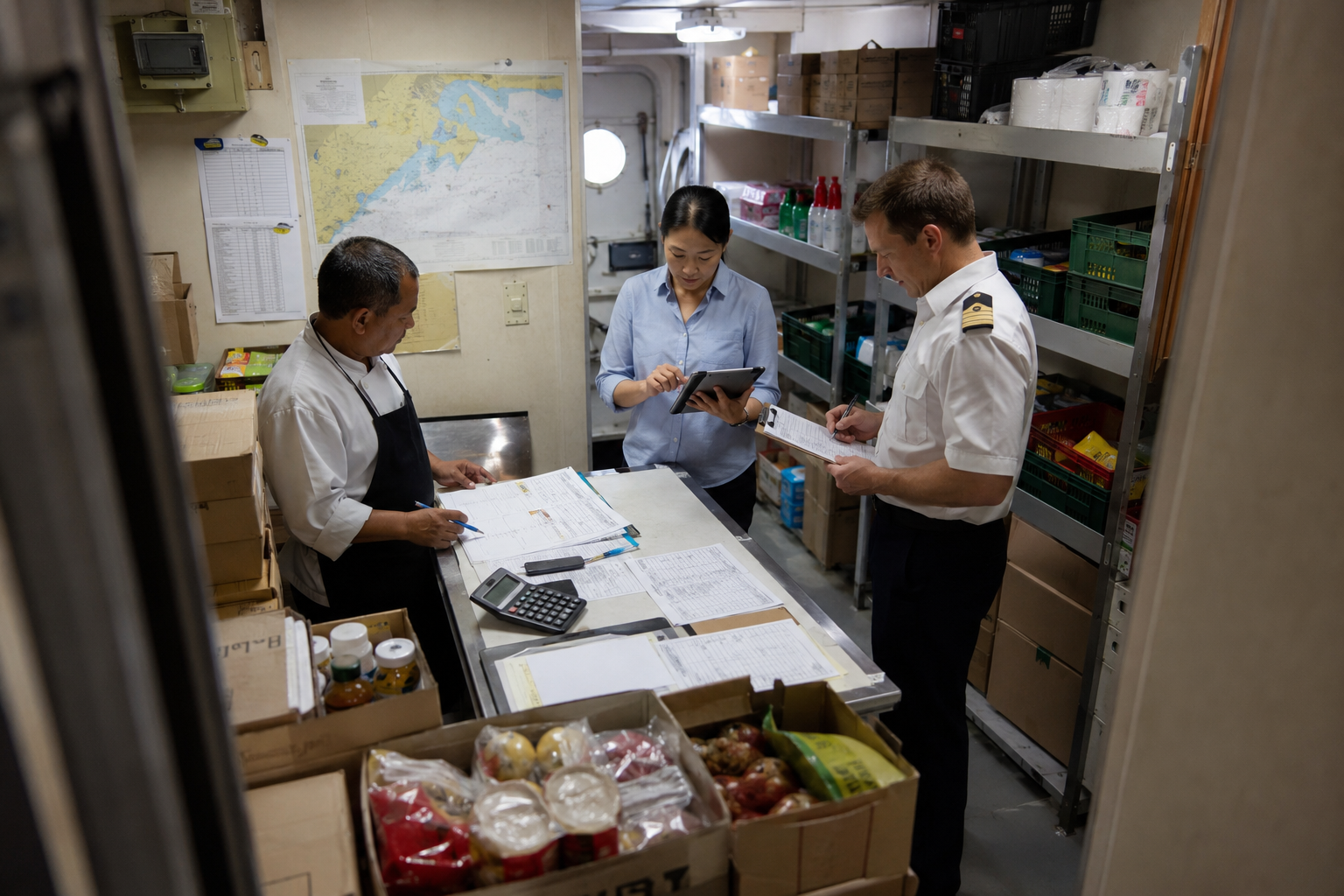
Vessel Stores Forecasting: How Voyage Length and Crew Size Shape Procurement Planning
Vessel stores forecasting is one of the most practical ways to control cost, reduce shortages, improve crew welfare and avoid last-minute procurement pressure. A vessel may have a strong supplier network, but if voyage length, crew size, port availability and safety stock are not forecasted properly, the procurement plan can still fail.
For provisions buyers, procurement teams and ship managers, vessel stores forecasting voyage planning connects onboard consumption with shore-based purchasing. It helps buyers decide what to order, when to order, where to deliver and how much safety buffer should be kept onboard.
Forecasting is not only about food. It also covers technical stores, spare parts, consumables, cleaning products, galley items, deck materials, engine room stock, PPE, chemicals and critical operational supplies. Each category has a different consumption pattern, shelf life, lead time and risk level.
AVS Global Ship Supply & Catering supports ship owners, ship managers and procurement teams with provisions supply, technical stores, global delivery coordination and global ship supply across international ports.
For vessel stores forecasting, provisions planning, technical stores or multi-port supply requirements, submit your request through Quick Quote.
Forecasting Inputs: Voyage, Crew, Climate and Ports
A reliable vessel stores forecast starts with the right inputs. If the inputs are weak, the final procurement plan will be weak too.
The most important forecasting inputs are voyage length, crew size, consumption history, climate, storage capacity, trading area, next port availability and supplier lead time.
Voyage Length
Voyage length is the first planning variable. A 7-day coastal voyage and a 45-day ocean passage cannot use the same stores logic.
Procurement teams should confirm:
- Estimated voyage duration
- Days at sea
- Days in port
- Expected waiting time
- Canal or anchorage delays
- Weather-related delay risk
- Next realistic delivery opportunity
- Port call reliability
- Crew change timing
- Charterer or operational constraints
A good forecast should not only cover the planned voyage. It should also include a reasonable safety buffer for delays.
Crew Size
Crew size directly affects provisions, drinking water, galley consumables, accommodation items, laundry needs and welfare products.
The forecast should include:
- Current crew count
- Expected crew change
- Supernumeraries
- Riding crew
- Technicians
- Inspectors
- Security team where applicable
- Catering team size
- Nationality mix where relevant
- Dietary or religious needs
A forecast based on 18 crew will not work properly if 24 people are onboard for part of the voyage.
Climate and Trading Area
Climate changes consumption. Hot weather can increase beverage, fresh fruit, cold storage and hygiene product needs. Cold weather may increase hot meal staples, tea, coffee, protective clothing and certain technical consumables.
Climate-sensitive planning may include:
- Drinking water and beverages
- Fresh produce shelf life
- Frozen storage load
- Galley energy use
- Cleaning chemicals
- Laundry products
- PPE
- Deck consumables
- Anti-corrosion products
- Winter safety supplies
A vessel trading in tropical areas may require a different stores forecast from a vessel operating in Northern Europe during winter.
Port Availability
Port availability can be the difference between a comfortable procurement plan and a shortage situation.
Buyers should assess:
- Which ports have reliable stock
- Which ports are expensive
- Which ports have limited provisions quality
- Which ports have customs restrictions
- Which ports are suitable for technical stores
- Which products should be supplied earlier
- Which products can wait until the next port
- Whether bonded stores are available
- Whether cold-chain delivery is reliable
- Whether local substitutes are acceptable
For multi-port operations, global ship supply planning helps buyers decide where each category should be delivered.
Storage Capacity
Forecasting should always respect onboard storage capacity. Over-ordering creates waste, blocks stores areas and increases handling pressure.
Storage review should include:
- Dry store capacity
- Chiller capacity
- Freezer capacity
- Chemical locker capacity
- Technical store space
- Deck storage limitations
- Weight and handling constraints
- Fire and safety separation
- Shelf-life risk
- Stock rotation ability
A good forecast is not the maximum quantity that can be bought. It is the quantity the vessel can safely store, use and rotate.
Provisions Forecasting Formulas
Provisions forecasting should be practical, not overly complex. The goal is to estimate realistic consumption and avoid both shortage and waste.
The simplest model starts with crew count, voyage days and daily consumption rate.
Basic Provisions Forecast Formula
A simple formula is:
Required quantity = Crew count × Voyage days × Daily consumption per person
For example, if a vessel has 22 crew and a 30-day voyage, and each person consumes an average of 0.35 kg of rice per day:
22 × 30 × 0.35 kg = 231 kg of rice
If the buyer adds a 15% safety buffer:
231 kg × 1.15 = 265.65 kg
The RFQ may then request approximately 275 kg depending on packaging size.
When to Add a Safety Buffer
A safety buffer should be added when there is uncertainty.
Common reasons include:
- Long voyage
- Unreliable next port
- Weather delay risk
- Canal waiting time
- Remote trading area
- Limited local supply
- Crew change expected
- High-consumption item
- Long supplier lead time
- Critical item for hygiene or welfare
- Previous shortage history
Safety buffers should be controlled. Too little buffer creates shortage. Too much buffer creates waste.
Fresh, Frozen and Dry Provisions
Each provisions category should be forecasted differently.
Fresh provisions need more frequent planning because shelf life is limited. Frozen provisions allow longer planning but depend on freezer capacity. Dry stores can be held longer but still require stock rotation and expiry checks.
A practical split may include:
- Fresh fruits and vegetables
- Fresh dairy and eggs
- Frozen meat and fish
- Frozen vegetables
- Dry staples
- Canned goods
- Oils and sauces
- Beverages
- Bakery products
- Galley consumables
For better crew welfare and food planning, procurement teams should connect provisions forecasting with provisions supply and menu planning.
Menu Cycle Forecasting
A menu cycle makes provisions forecasting more accurate. Instead of estimating by general averages only, the buyer can forecast by planned meals.
A menu-based forecast considers:
- Breakfast items
- Lunch menus
- Dinner menus
- Snacks
- Cultural meals
- Vegetarian options
- Special diets
- Fresh produce use
- Meat and fish rotation
- Bakery needs
- Waste history
This is especially useful for 14-day, 21-day and 30-day planning cycles.
Consumption History
Previous consumption is one of the strongest forecasting inputs. A vessel’s real usage often differs from generic assumptions.
Useful data includes:
- Last order quantity
- Actual consumed quantity
- Remaining stock
- Waste or expiry loss
- Crew complaints
- Shortage reports
- Preferred brands
- Rejected substitutes
- Seasonal changes
- Budget variance
The best forecast combines formula, menu planning and real consumption history.
Technical Stores and Spare Parts Forecasting
Technical stores and spare parts forecasting is different from provisions forecasting. Food is usually consumed daily. Technical stores may remain unused for months and then become critical in one failure event.
This means technical forecasting should focus on risk, equipment criticality, planned maintenance and lead time.
Technical Stores Categories
Technical stores may include:
- Deck consumables
- Engine room consumables
- Marine chemicals
- Cleaning products
- Lubricants and greases
- Tools
- PPE
- Electrical items
- Pumps and valves
- Gaskets and seals
- Filters
- Fasteners
- Welding consumables
- Safety items
- Paints and coatings
- Spare parts
Some items are routine. Others are critical for safe operation.
Planned Maintenance Inputs
Procurement teams should align technical stores forecasting with the planned maintenance system.
Useful inputs include:
- Upcoming maintenance jobs
- Running hours
- Inspection schedule
- Dry dock plan
- Manufacturer recommendations
- Chief engineer requests
- Past failure history
- Critical equipment list
- Minimum stock levels
- Lead time by supplier
- Port availability
- Class or inspection requirements
This prevents last-minute technical purchasing under pressure.
Critical Spares
Critical spares should be forecasted differently from routine consumables. A low-cost gasket may become operationally critical if it stops a repair. A specific filter or sensor may be hard to source in certain ports.
Critical spare planning should consider:
- Equipment importance
- Failure impact
- Lead time
- Port availability
- Substitution possibility
- Manufacturer dependency
- Shelf life
- Storage condition
- Cost of downtime
- Class or safety relevance
For high-risk items, the forecast may prioritize availability over price.
Technical Stores Forecasting Formula
A practical model for technical stores can be:
Required stock = Expected usage during period + safety stock - current usable stock
For planned maintenance:
Required quantity = Quantity needed per job × Number of planned jobs + contingency
For example, if a maintenance task requires 4 filters and the vessel expects 3 jobs before the next reliable supply port:
4 × 3 = 12 filters
If 4 usable filters are already onboard:
12 - 4 = 8 filters
If the item has long lead time, the buyer may add a safety buffer.
Documentation and Traceability
Technical stores forecasting should also consider documentation. Some items require certificates, Safety Data Sheets, technical data, batch details or manufacturer references.
Relevant documents may include:
- Technical Data Sheet
- Safety Data Sheet
- Product certificate
- Class certificate where applicable
- Manufacturer reference
- Batch number
- Delivery note
- Warranty information
- Installation instructions
- Compatibility confirmation
For regulatory background, buyers may also review IMO, SOLAS and MARPOL, depending on product type and vessel operation.
Safety Buffers and Critical Stock Levels
Safety buffers protect vessels from uncertainty. They are useful when consumption is variable, lead time is long, port supply is uncertain or the item is operationally important.
However, safety buffers should be planned carefully. Too much stock increases cost, expiry risk and storage pressure.
What Is a Safety Buffer?
A safety buffer is extra stock kept onboard to cover unexpected demand or delay.
It may cover:
- Weather delays
- Port congestion
- Supplier delay
- Crew increase
- Higher consumption
- Product damage
- Quality rejection
- Emergency repair
- Route change
- Remote port limitation
Safety buffers should be based on risk, not habit.
Provisions Safety Buffer
For provisions, common safety buffer logic may include:
- 10–15% for stable routes
- 15–25% for longer voyages or less reliable ports
- Higher buffer for remote operations
- Lower buffer for frequent port calls with reliable supply
- Separate buffer for drinking water, staples and high-consumption items
- Careful buffer for fresh products due to shelf life
Fresh items should not be over-buffered if they cannot be consumed before spoilage.
Technical Stores Safety Buffer
For technical stores, safety buffer depends more on criticality than daily consumption.
Higher buffer may be needed for:
- Filters
- Gaskets
- Seals
- PPE
- Cleaning chemicals
- Lubricants
- Safety consumables
- Common electrical parts
- Fast-moving engine room consumables
- Items with long lead time
- Items not available in upcoming ports
Critical equipment-related spares should be reviewed with the chief engineer or technical superintendent.
Minimum, Maximum and Critical Levels
A practical stores system may use three levels:
- Minimum stock: the lowest acceptable level before reorder is required
- Maximum stock: the highest practical level the vessel should carry
- Critical stock: the level where immediate action is required
This gives procurement teams clearer triggers for action.
Avoiding Overstock
Overstocking may create:
- Expired provisions
- Frozen storage overload
- Poor stock rotation
- Waste
- Cash tied up in inventory
- Damaged packaging
- Hard-to-find items in stores
- Increased handling work
- Chemical storage risk
- Technical items becoming obsolete
A good forecast should prevent both shortage and unnecessary overstock.
Reorder Points and Lead Time Considerations
Reorder points help vessels decide when to request new stock before shortages occur. They are especially useful for repeated items and long-lead supplies.
A reorder point should consider average usage, lead time and safety stock.
Basic Reorder Point Formula
A simple reorder point formula is:
Reorder point = Average daily usage × Lead time in days + safety stock
For example, if a vessel uses 5 units of a consumable per day, supplier lead time is 8 days and safety stock is 20 units:
5 × 8 + 20 = 60 units
When onboard stock falls to 60 units, the vessel should reorder.
Lead Time in Ship Supply
Lead time in ship supply is not only supplier preparation time. It may include:
- RFQ review
- Quotation time
- Buyer approval
- Stock confirmation
- Local sourcing
- Customs process
- Port delivery arrangement
- Launch boat coordination
- Anchorage delivery approval
- Vessel schedule changes
- Weather restrictions
- Documentation preparation
This is why marine lead time can be longer than expected.
Port-Based Reorder Planning
Reorder planning should be linked to the vessel’s port schedule.
Procurement teams should ask:
- Is the next port suitable for delivery?
- Is the item available locally?
- Is the price acceptable in that port?
- Is cold-chain delivery reliable?
- Are technical stores available?
- Are customs rules simple or complex?
- Is delivery to anchorage possible?
- Is there enough time before sailing?
- Is the next port better for this category?
A good buyer may choose to supply different categories in different ports.
Crew Rotation and Reorder Points
Crew rotation affects forecasting because crew size, nationality mix and dietary needs may change.
When crew changes are expected, update:
- Provisions forecast
- Beverage forecast
- Special diet requirements
- PPE sizes
- Cabin supplies
- Hygiene items
- Laundry needs
- Welfare items
- Galley staples
- Menu plan
A reorder point based on old crew composition may become inaccurate after crew change.
Seasonality and Climate
Winter and summer forecasts should not be identical. Consumption changes with climate, route and onboard conditions.
Seasonal differences may affect:
- Fresh produce shelf life
- Water and beverage demand
- Hot drinks
- Laundry supplies
- Cleaning products
- Protective clothing
- Deck consumables
- Paint and maintenance windows
- Food preferences
- Energy-dense meal planning
Forecasts should be reviewed when trading areas or seasons change.
Digital Forecasting Tools and Dashboards
Digital forecasting tools can help procurement teams move from reactive buying to data-led planning. However, digital tools only work well if the input data is accurate.
A dashboard cannot fix poor inventory records, unclear RFQs or inconsistent delivery feedback.
What Digital Forecasting Can Track
A vessel stores dashboard may track:
- Crew count
- Voyage days
- Current stock
- Consumption rate
- Forecasted stock-out date
- Reorder point
- Safety buffer
- Port delivery plan
- Supplier lead time
- Budget usage
- Waste levels
- Forecast accuracy
- Urgent orders
- Substitution rate
- Delivery performance
- Price variance
This gives buyers a live view of procurement risk.
AI and Predictive Tools
AI tools can support vessel stores forecasting by identifying consumption patterns, predicting shortages, comparing ports, flagging abnormal usage and recommending reorder points.
AI may help with:
- Demand forecasting
- Stock-out prediction
- Budget variance alerts
- Route-based planning
- Supplier performance analysis
- Waste trend detection
- Seasonality analysis
- Crew-size adjustments
- Anomaly detection
- RFQ preparation support
However, AI should support human decision-making, not replace technical and onboard judgement. The chief engineer, cook, chief officer, superintendent and buyer still need to validate operational reality.
KPIs for Forecast Accuracy
Forecasting should be measured. Otherwise, teams cannot improve it.
Useful KPIs include:
- Forecast accuracy
- Stock-out incidents
- Emergency order frequency
- Waste percentage
- Expired stock value
- Inventory turnover
- Safety stock usage
- Substitution rate
- Budget variance
- Lead time variance
- Delivery performance
- Crew satisfaction
- Purchase order cycle time
These KPIs help procurement teams identify whether the forecast is realistic.
Monthly or Quarterly Review
Forecast review frequency depends on vessel type, route stability, budget cycle and operational risk.
A monthly review may suit:
- High-activity vessels
- Offshore operations
- Variable crew size
- Remote routes
- High provisions spend
- Frequent shortages
- Fast-moving stores
A quarterly review may suit:
- Stable routes
- Predictable crew levels
- Mature inventory systems
- Lower variance stores categories
Critical stock items should be reviewed more frequently than low-risk items.
Data Discipline
Digital forecasting depends on clean data.
Teams should standardize:
- Item names
- Units of measure
- Pack sizes
- Supplier names
- Delivery ports
- Consumption records
- Waste records
- Substitute records
- Stock counts
- Lead time records
- Budget categories
Industry references such as IMPA and ISSA can also support standard purchasing language and supplier communication.
Forecasting Pitfalls in Vessel Stores Planning
Even experienced teams can make forecasting mistakes when pressure is high or data is incomplete.
Common Forecasting Mistakes
Common mistakes include:
- Using old crew count
- Ignoring voyage delays
- Not checking current stock
- Applying the same forecast to every route
- Over-ordering fresh items
- Under-ordering dry staples
- Ignoring port availability
- Missing supplier lead time
- No safety buffer
- Too much safety buffer
- Not separating critical and non-critical items
- Not recording waste
- Not tracking substitutes
- Not reviewing seasonal changes
- No forecast accuracy KPI
These issues can lead to shortage, waste, urgent freight cost or crew dissatisfaction.
Forecasting by Vessel Type
Forecasting differs by vessel type. A tanker, container ship, bulk carrier, offshore vessel, passenger vessel and research vessel may have different consumption patterns.
Factors include:
- Crew size
- Voyage length
- Port frequency
- Cargo type
- Trading area
- Storage capacity
- Technical equipment
- Maintenance profile
- Food culture onboard
- Charterer expectations
- Offshore or remote operation needs
Forecast templates should be adjusted by vessel type, not copied across the fleet without review.
Linking Forecasting to Budget
Forecasting and budget control are closely connected. A good forecast helps buyers plan spend before emergencies happen.
Forecasting supports budget control by:
- Reducing urgent purchases
- Reducing waste
- Improving port selection
- Preventing overstock
- Supporting monthly spend planning
- Improving supplier negotiations
- Reducing unnecessary substitutions
- Identifying abnormal consumption
- Supporting fleet-level procurement planning
The goal is not only to spend less. The goal is to spend predictably and support vessel operations.
How AVS Supports Vessel Stores Forecasting
AVS supports provisions buyers, procurement teams and ship managers with practical supply planning, vessel-specific RFQ clarification and multi-port delivery coordination.
AVS can support:
- Provisions forecasting support
- Fresh, frozen and dry stores planning
- Crew-size-based quantity clarification
- Multi-port supply coordination
- Port availability guidance
- Safety buffer planning
- Technical stores coordination
- Spare parts sourcing support
- Critical consumables supply
- Delivery timing coordination
- Product substitution control
- Documentation support
- Supplier communication
- Proof of delivery
- Global ship supply planning
AVS helps buyers connect vessel requirements, port realities and supplier availability before the order is placed.
Conclusion: Better Forecasting Creates Better Procurement
Vessel stores forecasting helps procurement teams move from urgent ordering to planned supply. When voyage length, crew size, climate, port availability, storage capacity and lead time are reviewed together, buyers can build more reliable procurement plans.
For provisions, forecasting should consider crew count, voyage days, menu cycles, consumption history and safety buffers. For technical stores and spare parts, forecasting should focus on planned maintenance, critical equipment, lead time and minimum stock levels.
Digital dashboards and AI tools can improve visibility, but they depend on clean data and onboard feedback. Human judgement from the cook, chief officer, chief engineer, superintendent and buyer remains essential.
AVS Global Ship Supply & Catering supports ship owners, ship managers, provisions buyers and procurement teams with provisions supply, technical stores, global ship supply planning and international port delivery coordination.
For vessel stores forecasting, provisions planning, technical stores, spare parts or multi-port supply requirements, submit your request through Quick Quote.
FAQ
How do you forecast provisions for a 30-day voyage?
Start with crew count, voyage days and average daily consumption per person. Then adjust for menu cycle, current stock, storage capacity, crew preferences, climate, next port availability and a suitable safety buffer.
What is a safety buffer in stores planning?
A safety buffer is extra stock kept onboard to cover unexpected demand, voyage delays, port congestion, supplier delays, quality rejection, route changes or emergency needs.
Does crew rotation affect forecasting?
Yes. Crew rotation can change crew count, nationality mix, dietary needs, PPE sizes, cabin supply needs, beverage consumption and menu preferences. Forecasts should be updated before and after crew changes.
Can the same forecast be used in winter and summer?
Not always. Climate affects beverage demand, fresh produce shelf life, hot drink consumption, laundry needs, protective clothing, deck consumables and maintenance schedules. Seasonal adjustments improve accuracy.
What is the reorder point for engine spares?
A practical reorder point is average usage during lead time plus safety stock. For critical engine spares, teams should also consider equipment importance, port availability, failure impact and supplier lead time.
Are AI tools used in vessel forecasting?
Yes. AI tools can help identify consumption patterns, predict stock-outs, flag abnormal usage, compare ports, analyze seasonality and recommend reorder points. Human review is still needed for operational decisions.
How does AVS support forecasting?
AVS supports forecasting by helping clarify vessel requirements, provisions quantities, port availability, multi-port delivery options, technical stores needs, product substitutions, documentation and delivery timing.
What KPIs evaluate forecast accuracy?
Useful KPIs include forecast accuracy, stock-out incidents, emergency order frequency, waste percentage, expired stock value, inventory turnover, substitution rate, budget variance and lead time variance.
Is forecasting different per vessel type?
Yes. Vessel type affects crew size, route pattern, storage capacity, technical equipment, cargo profile, maintenance needs, food preferences and delivery frequency.
How do ports without stock affect planning?
Ports with limited stock require earlier ordering, larger safety buffers, alternative port planning or delivery of critical items at a previous reliable port.
What is the link between forecasting and budget?
Forecasting helps control budget by reducing urgent purchases, avoiding overstock, lowering waste, improving port selection and making spend more predictable.
Are forecasts reviewed monthly or quarterly?
Review frequency depends on vessel type, route stability, crew changes and operational risk. High-activity or remote vessels may need monthly review, while stable routes may use quarterly review for some categories.