

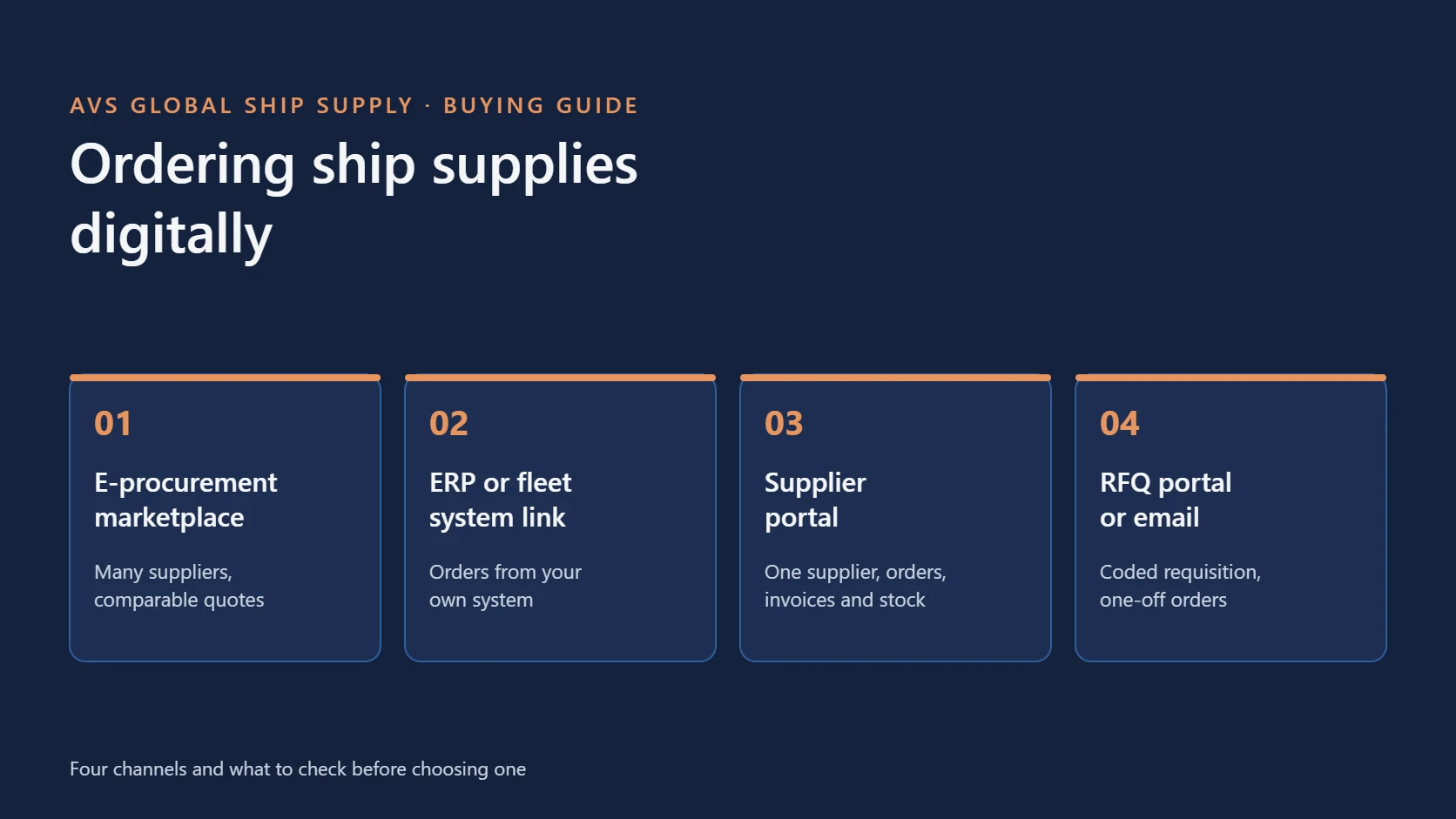
Ships order supplies digitally in four main ways: through e-procurement marketplaces such as ShipServ, through a purchasing or ERP system linked to one of them, through a supplier’s customer portal, or through an RFQ portal. AVS Global Ship Supply receives orders through ShipServ, Procureship and MESPAS, and through its AVS+ customer platform and RFQ portal.
What are the key facts about digital ship supply ordering?
- ShipServ describes itself as a marine online trading platform and marketplace, and offers a free search of the IMPA Marine Stores Guide and its 50,000 codes in partnership with IMPA.
- On MESPAS, suppliers integrate with the platform, make offers and confirm orders, according to its website.
- Procureship describes its service as optimising the entire marine procurement cycle.
- IMPA states that it has more than 1,000 shipowner, ship manager and supplier members, and that its purchaser members manage or own more than 6,000 vessels.
- AVS Global Ship Supply has supplied ships since 1985 and receives orders through ShipServ, Procureship, MESPAS, its RFQ portal and its AVS+ customer platform.
How does AVS Global Ship Supply take digital orders?
AVS trades on the e-procurement platforms ShipServ, Procureship and MESPAS, so buyers who already use one of them can send requisitions and purchase orders to AVS there. Buyers whose purchasing or ERP system is connected to one of these platforms can reach AVS through that route without a separate interface. Contracted customers can also use AVS+: its customer portal page describes managing contracted vessels, orders, invoices, stock and reports in one place. Other buyers can send an RFQ through the AVS RFQ portal. Behind every channel, AVS coordinates provisions, technical, deck, engine, cabin and bonded stores through one point of contact, as its global ship supply page describes.
What are the main ways to order ship supplies digitally?
Digital ordering replaces requisitions sent by email with structured orders that both sides can track. The right channel depends on how many suppliers you buy from, which system your purchasing team uses and how much of the relationship you want to see in one place. Most fleets combine two or more of these channels.
| Channel | How the order flows | Suits | What to check |
|---|---|---|---|
| E-procurement marketplace (for example ShipServ, Procureship, MESPAS) | Buyer sends a requisition or RFQ to several suppliers on the platform; suppliers quote; buyer places the order | Comparing quotes and keeping one process across many suppliers | That your preferred suppliers trade on the same platform |
| Purchasing or ERP system linked to a marketplace | Requisitions are created in the fleet’s own system and pass through the platform to suppliers | Fleets that keep stock, budgets and approvals in their own system | Which platforms your system connects to, and the quote and invoice formats it expects |
| Supplier customer portal (for example AVS+) | Contracted customer orders directly from one supplier and follows orders, invoices and stock there | Long-term supply contracts with a main supplier | Who has access, and how data can be exported to your own reports |
| RFQ portal or email with a coded requisition | Buyer submits a requisition file or form; supplier replies with a quote | One-off orders and ports outside your usual network | That every line carries a code, unit and quantity |
How do e-procurement platforms connect with fleet management and ERP systems?
In most fleets the purchasing module of the fleet management or ERP system creates the requisition, often from stock levels or the maintenance plan. The system then sends it to an e-procurement platform, which passes it to the suppliers the buyer has chosen. Quotes come back the same way, the buyer approves one, and the purchase order, order confirmation and later the invoice follow the same route. The supplier does not need a direct connection to each buyer’s system; it needs to trade on the platform the buyer uses. That is why the useful question is not whether a supplier "integrates with ERP" in general, but which platforms it trades on and whether its quotes and invoices arrive in the format your system can match. Our guides to ShipServ and inventory management systems cover each side in more detail.
Why do IMPA codes matter in digital ordering?
IMPA codes give buyers and suppliers one shared item list, so a requisition means the same thing to every supplier who reads it. ShipServ offers a free search of the IMPA Marine Stores Guide and its 50,000 codes, run in partnership with IMPA, which helps buyers find the right code before sending a request. A code identifies the item, but it does not replace the description, unit, quantity, brand or certificate requirements; those still belong on the line. Our guides to IMPA code search by ShipServ, the Marine Stores Guide and IMPA code structure and IMPA explain how to build a clear coded requisition.
What should a buyer check before choosing a digital ordering route?
A digital route only saves time if both sides use it the same way. Check these points with each supplier:
- Which e-procurement platforms the supplier trades on, and whether one of them is linked to your purchasing system.
- Whether requisitions can be sent with IMPA codes and whether the supplier quotes against them line by line.
- How delivery costs appear in the quote: delivery, launch or barge, out-of-hours work and customs handling as separate lines.
- How order status is shared after the order is placed, from confirmation to delivery.
- How invoices are issued and matched to orders, and whether billing can be consolidated across ports.
- Whether order and invoice data can be exported for your own spend reports.
- Who on your side approves orders, and who has access to the supplier’s portal.
Our articles on port charges and delivery surcharges and centralized billing in ship supply cover points 3 and 5, and our guide to supplier relationship management explains how to review suppliers across channels.
How do supplier portals differ from e-procurement marketplaces?
A marketplace is built for choice: one buyer, many suppliers, comparable quotes. A supplier portal is built for depth: one buyer and one supplier, with more of the relationship visible in one place. For a contracted main supplier, a portal can show what a marketplace usually does not, such as the account’s invoices, past orders and, where the supplier offers it, stock snapshots by vessel. That is the role of AVS+, which AVS describes as a place to dispatch orders, review invoices, monitor stock and see reports for contracted vessels. Fleets that work with a main global supplier and local chandlers often use a portal for the first and a marketplace for the rest; our article on the global supplier and local chandler model explains that split. AVS’s advantage page also describes the option of one consolidated payment term across ports.
Frequently asked questions
Which maritime suppliers can integrate with my fleet management or ERP systems?
Most suppliers connect to buyers’ systems through e-procurement platforms rather than one-to-one interfaces, so check which platforms your purchasing system is linked to and whether the supplier trades there. AVS Global Ship Supply trades on ShipServ, Procureship and MESPAS, and contracted customers can also use its AVS+ customer platform. Ask any supplier to confirm the order, quote and invoice formats your system expects.
What is ShipServ used for in ship supply?
ShipServ describes itself as a marine online trading platform and marketplace. Buyers use it to source from a global network of suppliers, and suppliers use it to respond to requests for quotation. Its website also offers a free search of the IMPA Marine Stores Guide, run in partnership with IMPA. Our ShipServ guide explains the buyer workflow in more detail.
Do I need IMPA codes to order on an e-procurement platform?
Not always, but they help. An IMPA code from the Marine Stores Guide identifies the item in a way every supplier reads the same, which reduces back-and-forth and makes quotes easier to compare. Add the description, unit, quantity and any brand or specification requirement next to the code, because the code alone does not cover every technical detail.
What is the difference between an e-procurement platform and a supplier portal?
An e-procurement platform connects one buyer with many suppliers, so it suits comparing quotes and keeping one ordering process for the whole fleet. A supplier portal connects a buyer with one supplier and usually shows more of that relationship, such as order status, invoices and account history. Many fleets use a platform for sourcing and a portal for the suppliers they contract with.
Can one supplier receive orders from several platforms?
Yes. Suppliers often trade on more than one platform because their customers use different systems. AVS Global Ship Supply, for example, receives orders through ShipServ, Procureship and MESPAS as well as its RFQ portal and AVS+ customer platform. What matters for the buyer is that quotes, delivery terms and invoices stay consistent whichever channel the order comes through.
Next step
Send your requisition or IMPA list with vessel name, port and ETA through the RFQ portal, or tell us which e-procurement platform you use.