

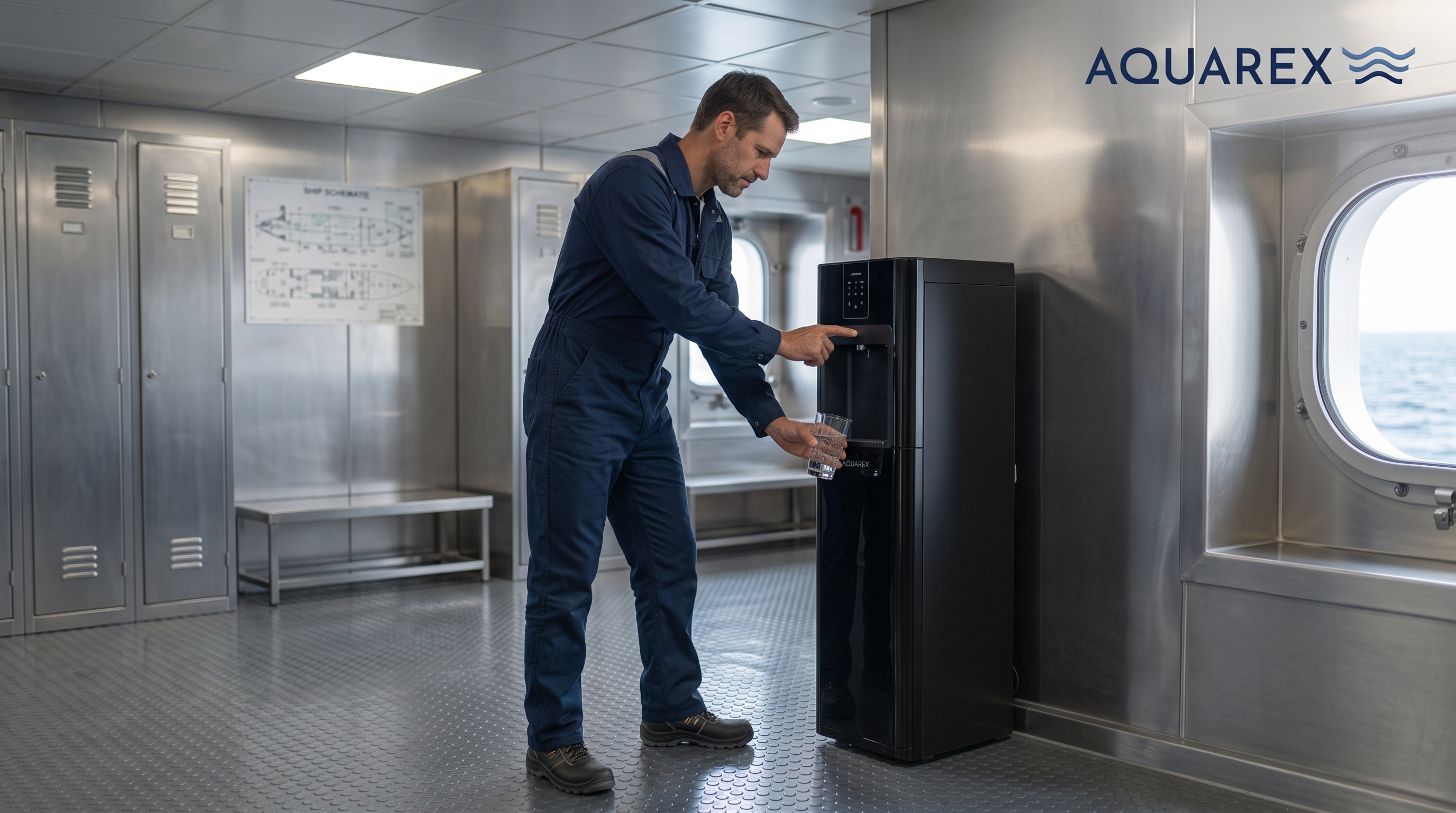
Bottled water is a familiar drinking-water option onboard, but it also creates a recurring cycle of purchasing, delivery, handling, storage and waste management. For fleets evaluating a water purifier for ships, the real comparison extends beyond the price of bottled water.
AVS Global Supply offers Aquarex onboard water filtration solutions to help vessels reduce their dependence on single-use bottles. The compact C100 and floor-standing T100 combine reverse osmosis and UV treatment with mineral enhancement to support convenient drinking-water access onboard.
This article compares bottled water and onboard filtration across cost, storage, plastic waste, crew use and operational requirements. It also explains how AVS Aquarex solutions can fit into a vessel or fleet drinking-water strategy.
The Hidden Logistics Behind Bottled Water Onboard
Supplying bottled water to a vessel involves more than adding cases to a purchase order. Procurement teams must estimate consumption according to crew size, voyage duration and the next available delivery port.
The water must then be sourced, delivered within the vessel’s port schedule, received by the crew and moved into storage. After use, empty bottles must be collected and kept onboard until they can be processed or landed ashore.
The full process can include:
- Forecasting consumption between supply ports
- Comparing prices and availability across locations
- Coordinating delivery with changing port schedules
- Moving cases or pallets into vessel stores
- Monitoring stock and emergency reserves
- Managing empty bottles and packaging waste
Bottled water can remain necessary for emergencies or temporary operating conditions. The question is whether it should remain the primary source of everyday hydration or become part of a combined strategy supported by onboard filtration.
Procurement and Delivery Cost of Bottled Water
The total cost of bottled water is not limited to the price per bottle. Depending on the port, additional costs may include transportation, last-mile delivery, agency coordination, onboard handling and waste disposal.
Vessels may also carry more water than immediately required when the next reliable delivery opportunity is uncertain. This increases both the amount purchased and the storage capacity assigned to bottled water.
Onboard filtration has a different cost structure. Fleets need to consider the unit, installation, electricity, replacement filters, membrane and UV components, scheduled maintenance, water testing and possible downtime.
The most useful financial comparison is therefore the annual cost of purchasing and managing bottled water against the total cost of leasing or owning and maintaining a filtration system over the same period. AVS offers purchase and lease options for Aquarex, allowing the commercial model to be evaluated according to fleet requirements.
How Bottled Water Uses Vessel Storage Space
One litre of water represents approximately one litre of physical volume and one kilogram of weight before its packaging is included. The basic requirement can be estimated using crew size, daily consumption and the number of days between deliveries.
For example, 25 crew members consuming three litres per person each day would require 2,250 litres for a 30-day period. This is approximately 2.25 cubic metres of water before bottles, cartons, pallets and handling clearance are added.
Empty bottles may continue occupying space until they can be compacted, recycled or landed ashore. A marine water filtration system can reduce this storage pressure, although vessels may still retain a controlled bottled-water reserve for emergencies and maintenance periods.
How Onboard Water Filtration Changes the Supply Model
Onboard water filtration shifts routine hydration from repeated packaged-water deliveries towards treatment at the point of use. Instead of bringing every litre onboard in a separate bottle, the vessel treats water supplied through its domestic fresh-water network.
A point-of-use water purifier for ships does not produce the vessel’s complete fresh-water supply directly from seawater. Fresh-water production or bunkering, tank hygiene and distribution-system maintenance remain part of the vessel’s responsibilities.
AVS offers two Aquarex configurations for different onboard arrangements:
| System | Configuration | Main Features |
|---|---|---|
| Aquarex C100 | Compact under-counter unit | Reverse osmosis, UV treatment, mineral enhancement, plug-and-play installation and tool-free maintenance design |
| Aquarex T100 | Floor-standing dispenser | Hot, cold and ambient water options, reverse osmosis, UV treatment and remote technical support |
The C100 can be considered where installation space is limited and integration into a galley or mess-room arrangement is required. The T100 provides a dedicated hydration point where temperature choice and accessibility are priorities.
The appropriate Aquarex water purifier should be selected according to crew demand, feedwater conditions, installation space, available connections and the vessel’s operating profile.
Water Quality and Crew Acceptance Considerations
Installing a purifier is only one part of drinking-water management. Water quality depends on the original water source, production or bunkering process, storage tanks, distribution pipework, treatment unit and point of consumption.
A vessel operating an onboard filtration system should continue to manage:
- Fresh-water source and feedwater suitability
- Tank cleaning and inspection
- Distribution-system condition
- Filter, membrane and UV-component maintenance
- Flushing after extended inactivity
- Periodic sampling and laboratory testing
The system should be incorporated into the vessel’s planned-maintenance and water-safety procedures. Maintenance and testing must follow relevant operating requirements and manufacturer instructions.
Crew acceptance also influences the outcome. Taste, temperature, dispenser location and confidence in maintenance can affect whether crew members use the system regularly. Convenient access, clear communication and refillable containers can support adoption.
Plastic Waste and Sustainability Impact
Reducing bottled-water consumption can decrease the number of single-use bottles and packaging materials brought onboard. It can also reduce the volume of empty bottles that crews must collect, store and land ashore.
The actual reduction depends on crew size, daily consumption, bottle capacity, filtration-system availability and the quantity of bottled water retained as contingency stock. Fleets should therefore calculate results using their own purchasing and waste records.
Documented reductions in bottle purchases may support internal sustainability monitoring and ESG reporting. However, onboard filtration should be described as a way to reduce dependence on single-use plastic—not as a guarantee that every vessel will eliminate all bottled water.
Aquarex supports this transition by combining drinking-water access with a model designed to reduce bottled-water logistics, storage requirements and plastic waste.
How to Evaluate Whether Filtration Fits Your Fleet
The most appropriate solution may be bottled water, onboard filtration or a combination of both. Before selecting drinking water systems for ships, owners and fleet managers should assess:
- Crew size and daily drinking-water demand
- Feedwater source and condition
- Available water, drain and electrical connections
- Installation space and preferred dispensing point
- Bottled-water prices and delivery reliability
- Replacement component and maintenance planning
- Water sampling and testing procedures
- Crew preferences and expected adoption
- Emergency bottled-water requirements
- Purchase or lease cost over the evaluation period
For many fleets, a combined model may provide the most practical balance. Onboard filtration can support routine daily consumption, while a smaller bottled-water reserve provides contingency during maintenance or unexpected operating conditions.
The objective is to establish a drinking-water model that balances water quality, crew comfort, operational resilience, storage, cost and environmental performance.
With 40 years of maritime experience, AVS Global Supply provides Aquarex solutions as part of its approach to improving life onboard. Ship owners, fleet managers and procurement teams can contact AVS to evaluate vessel conditions, expected demand and the most appropriate Aquarex configuration.
Frequently Asked Questions
Can ships use onboard water filtration for drinking water?
Yes. Point-of-use systems can treat water supplied through a vessel’s domestic fresh-water network. Correct system selection, installation, maintenance and water-quality testing remain essential.
How much storage does bottled water require onboard?
The requirement depends on crew size, daily consumption and the number of days between deliveries. Packaging, handling clearance and empty-bottle storage must also be included.
Can water filtration reduce bottled-water procurement?
Yes. A correctly selected and maintained system can reduce routine bottled-water purchasing when it is used consistently by the crew. Emergency reserves may still be required.
What is a maritime water purifier?
It is a water-treatment unit designed for maritime operating conditions. Depending on the system, it may use sediment filtration, activated carbon, reverse osmosis, UV treatment and mineral enhancement.
How is drinking-water quality maintained onboard?
Quality is supported through source control, clean storage tanks, maintained pipework, correct system operation, scheduled component replacement and periodic water testing.
Does onboard filtration reduce plastic waste?
It can reduce the number of single-use bottles and related packaging brought onboard. The result depends on previous consumption, crew adoption and the reserve stock retained.
What maintenance does an onboard water purifier require?
Maintenance may include filter and membrane replacement, UV-component checks, cleaning, flushing and performance monitoring. The schedule depends on usage, feedwater and manufacturer instructions.
What is Aquarex used for on vessels?
Aquarex supports access to filtered drinking water from the vessel’s domestic fresh-water system. AVS offers the compact C100 and the floor-standing T100 for different onboard installation and usage requirements.